
Reviewed · KATHMANDU UNESCO HERITAGE TOURS
Old Kathmandu Walking Tour, Historic World Heritage Durbar Square
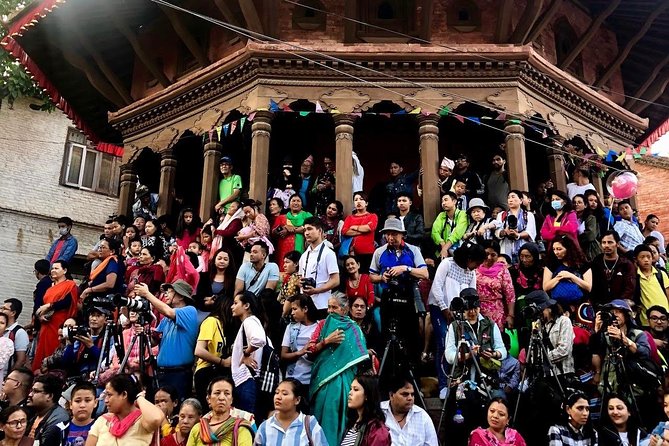
Kathmandu reveals itself best on foot, one quiet courtyard and crowded market lane at a time. This half-day walk links old Newar neighborhoods with Kathmandu Durbar Square, the Kumari shrine, Buddhist bahals, Hindu temples, and the everyday trade of Asan. It gives you the famous sights, but also the small places you would likely pass without a guide.
I like the mix of major sights and lesser-seen corners, especially Bikramshila Mahavihar, the monastery that gave Thamel its name, and the old courtyards around Itum Bahal. I also like the personal finish: tea or coffee at Cafe Mitra with your guide, when you can ask questions without rushing. The main consideration is pace. Four to five hours of walking through old lanes, with entrance fees extra, may feel long if you want a gentle morning.
Key points at a glance
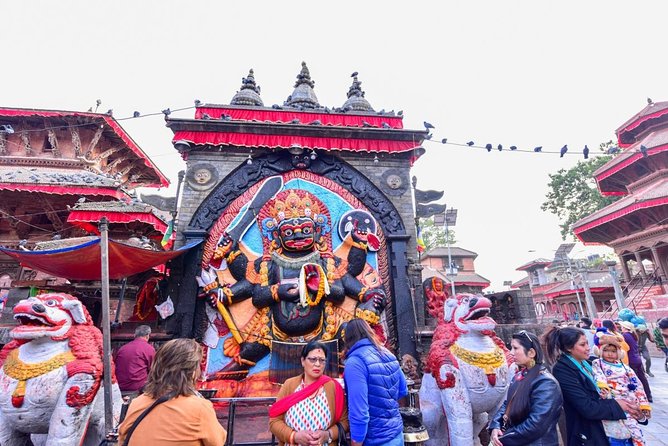
- A walking route through old Kathmandu: See markets, temples, monasteries, courtyards, and palace squares in one morning.
- Bikramshila Mahavihar: Visit a quiet Buddhist monument linked to the name Thamel.
- Asan market: Watch local commerce unfold around food, clothing, metal goods, and religious items.
- Kathmandu Durbar Square and Kumari Chowk: Explore the former royal center and the home of Nepal’s living goddess.
- Private group format: Only your own group takes part, with pickup offered in the tourist area.
- Tea with the guide: End at Cafe Mitra with a drink and an informal conversation about what you have seen.
Why this walk helps you understand Kathmandu
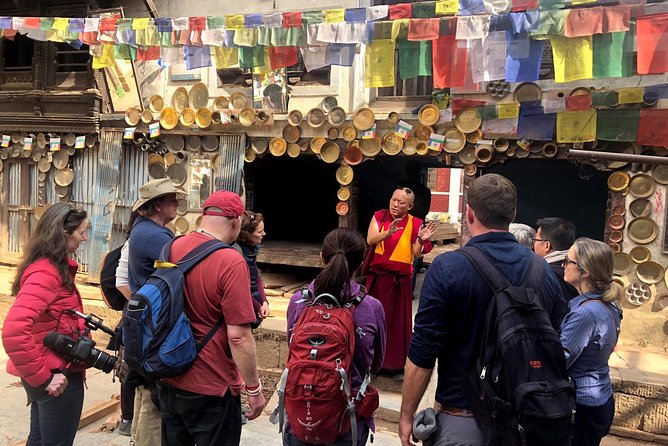
Kathmandu can feel confusing at first. A single street may carry vegetable sellers, worshippers, motorcycles, shrines, and old brick buildings at the same time. This tour gives that mixture some order without sanding away its rough edges.
You move through places tied to both Buddhist and Hindu practice. That matters in Kathmandu, where shrines and temples often share the same neighborhood and local religious life is part of the street scene. The route also brings together two sides of the city: the major monuments that belong on a first visit and the small public courtyards that are easy to miss.
The tour starts at 9 a.m. and lasts roughly four to five hours. If you are staying around Thamel, pickup can begin at your hotel lobby. Otherwise, transportation takes you to the starting point, described as about a 20-minute drive. The walk ends back in Thamel at Cafe Mitra, with hotel drop-off possible when your hotel is within the arranged area.
Because the tour is private, your group sets the rhythm more easily than on a large group outing. You can ask why a shrine matters, pause for photographs, or spend more time on a detail that catches your attention. The tradeoff is that the price may be less attractive for a solo visitor than for a couple or small group, although group discounts are offered.
More temple and square walks around Kathmandu:
- Private Kathmandu Sightseeing Tour | UNESCO World Heritage sites
★ 5.0 · 756 reviews - Kathmandu: Full Day 7 UNESCO Tour with Lunch – Private/Group
★ 5.0 · 415 reviews - Private Bhaktapur and Nagarkot Day Tour From Kathmandu
★ 5.0 · 305 reviews
Bikramshila Mahavihar and the story behind Thamel
The first stop, Bikramshila Mahavihar, is a smart way to begin. This old Buddhist monument of the Newar people is also called Thambahil, and Thamel takes its name from it. Many visitors know Thamel as Kathmandu’s restaurant and hotel district, but this stop points to the older settlement beneath the tourist layer.
You are given about 15 minutes here. That is enough for an introduction to the monument and its place in local culture, but not enough for a long architectural study. The admission is free, so you can focus on the guide’s explanation rather than ticket arrangements.
I especially like this opening because it changes how you see the streets afterward. Thamel is not just a convenient base for a Nepal trip. It sits beside older religious and urban traditions, and the first stop gives you that context before the route moves toward the market.
Asan market, where Kathmandu shops
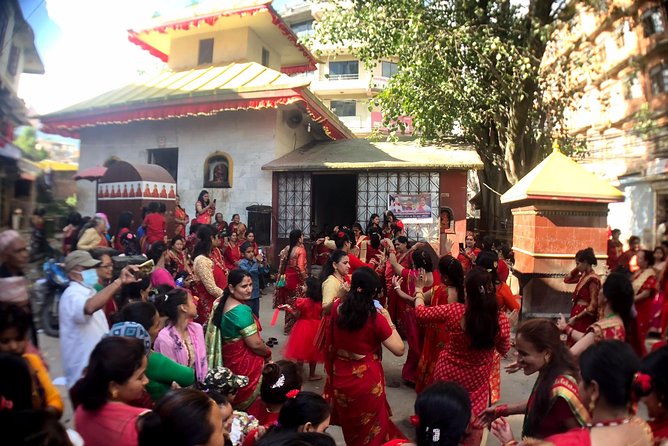
Asan is the route’s most immediate encounter with daily city life. It is described as Kathmandu’s oldest living market, and the goods reflect ordinary needs rather than a staged cultural display. You may see food, clothing, metal objects, and religious items changing hands in the same compact area.
The stop lasts about 15 minutes and has no separate admission fee. That is a short window, so do not expect a detailed shopping session. Instead, use it to notice how the market works: what is being sold, who is buying, and how commerce shares space with devotional activity.
This is also a place where a guide adds real value. A local guide can explain the purpose of objects that may otherwise look similar to you, and can help connect the market to Kathmandu’s religious calendar and home life. The route description points to a local saying that at Asan you can find almost anything. Even if you are not buying, it is a useful place to get your bearings in the old city.
Keep your attention on the walking itself. Market lanes can be crowded, and the experience is more about observation than leisurely strolling. If you dislike busy streets, this may be one of the harder sections, but it is also one of the most direct ways to see present-day Kathmandu.
Janabaha Dyo and the many forms of compassion
Janabaha Dyo, also called the Seto Machhindranath Temple, introduces the Buddhist side of Kathmandu’s shared religious life. The deity is linked with Avalokitesvara, the figure associated with compassion, and the shrine contains 108 engraved images representing different forms.
The planned stop is about 15 minutes, with no admission charge. That makes it a compact visit, but the number 108 gives your guide a useful subject to explain. You are not simply looking at one central image. The temple presents a wider set of representations and devotional ideas.
This is the kind of place where a quick solo visit may leave you with only a name and a photograph. With a guide, you can ask how the shrine fits into local Buddhist and Hindu practice. The route does not treat Kathmandu’s faiths as separate museum displays. It shows them in the same old neighborhoods, often only a few steps apart.
A few more things to do in Kathmandu worth a look
- UNESCO Seven World Heritage Tour in Kathmandu
★ 5.0 · 253 reviews - Kathmandu Private Sightseeing Tour | UNESCO World Heritage Sites
★ 5.0 · 109 reviews - Kathmandu: Full Day Private Top 4 UNESCO Heritage Tour W/Lunch.
★ 5.0 · 86 reviews - Kathmandu World Heritage Tour
★ 5.0 · 74 reviews
Itum Bahal and the courtyards beyond the main streets
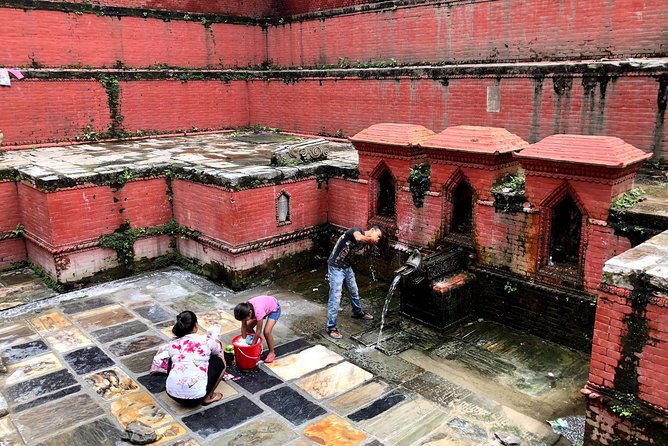
Itum Bahal takes about 30 minutes, making it one of the longer stops before Durbar Square. This 11th-century Buddhist monastic complex once covered a larger area. What remains includes part of the original monastic building and courtyards connected with the goddess Tara.
The word bahal refers to a type of traditional Buddhist courtyard, and this stop helps you understand why Kathmandu’s old city cannot be judged only from its main squares. Some of the most memorable spaces are set just behind ordinary street fronts. You may walk through a narrow entrance and find a calm communal court that is easy to overlook without local direction.
I would give this stop your full attention. The quiet change of pace after Asan is part of its appeal. It also helps explain the Newar character of the city, where architecture, religion, and neighborhood life are closely linked.
The tour’s short time at each early stop means you will not study every carving or building. That is a fair limitation for a half-day route, but it is worth knowing if you prefer long visits at one monument. This experience favors variety and connections over exhaustive examination.
Kathmandu Durbar Square and the royal center
Kathmandu Durbar Square is the route’s main monumental stop. The square was the palace center of Nepal’s kings, with temples and traditional buildings surrounding the former royal complex. You have about 45 minutes here, followed by another 20 minutes at Kumari Chowk.
This is where the tour’s extra cost matters. Admission to the Kathmandu Durbar Square premises is not included, and the fee amount is not stated in the available details. Budget for a separate entrance payment before you arrive. The same information also lists an entry fee for Swayambhu Stupa, although the walking description centers on Kathesimbu, a related Buddhist stupa complex, so it is sensible to confirm exactly which entrance charges apply when booking.
The square rewards a guide who can point out details you would otherwise miss. The buildings are not simply a backdrop for photographs. They show the traditional art and architecture of the Kathmandu Valley, with carved wood, religious images, palace spaces, and temples gathered in a tight urban setting.
Forty-five minutes is enough for a useful overview, especially after the earlier neighborhood stops. It is not enough to see every corner at a slow pace. If Durbar Square is your highest priority, arrive ready to stay focused and ask your guide to help you choose the most important buildings.
Kumari Chowk and the living goddess
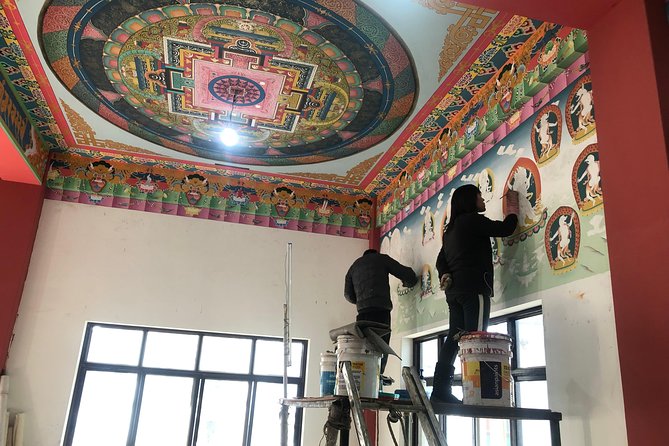
Kumari Chowk is within the Durbar Square area and is home to Kumari, the living goddess. The building is about 300 years old and is itself an important example of traditional architecture.
A visit here can be one of the most striking parts of the morning, but expectations should be realistic. The experience may include a chance to see Kumari, though that is not guaranteed. The route description specifically notes that you might be fortunate, so do not treat an appearance as a promised feature.
The shrine also calls for respectful behavior. You are entering a religious space, not a theater. Listen carefully to instructions from your guide and avoid treating the visit as a photo opportunity first and a sacred place second.
The reviews supplied for this experience place particular emphasis on seeing the living goddess. One guide, Modo, was singled out for helping make the visit meaningful, while Mahesh Shreshtha was praised for his experience guiding the walk. Guide assignments can vary, but the named examples show the kind of local interpretation you should expect.
Kathesimbu and the old route back to Thamel
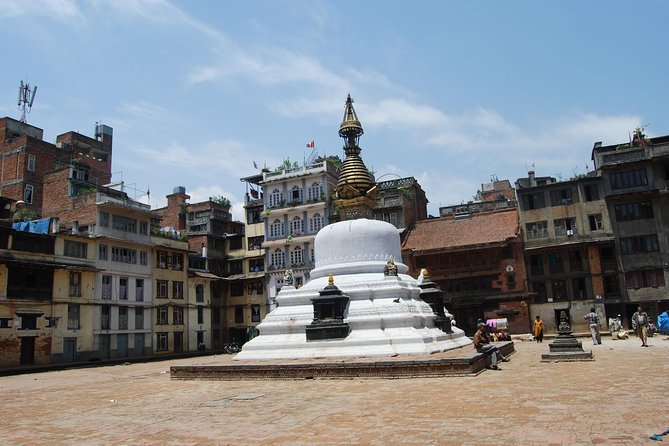
After Durbar Square, the walk continues through the old town to Kathesimbu, also called Dharmakirti Vihara. This Buddhist stupa complex contains a replica of Swayambhu Stupa, one of Nepal’s most important pilgrimage sites.
The stop adds a useful connection to the wider Kathmandu Valley. You have already seen monasteries and courtyards, but Kathesimbu shows how important Buddhist forms were repeated in smaller neighborhood settings. It is not presented as a replacement for visiting Swayambhunath, but as a local stupa complex with its own place in the city.
The exact time allotted to this stop is not stated. That uncertainty is worth noting if you like a tightly timed schedule. The route then heads back toward Thamel, giving you a final walk through the older streets before the modern tourist district returns.
Tea at Cafe Mitra and time for questions
The tour ends at Cafe Mitra on Thamel Marg, where coffee or tea is included. You can use this half-hour as more than a break. It is the best time to ask about a temple you did not understand, clarify what you saw in the market, or discuss places to visit next in Nepal.
I like this ending because the conversation is built into the experience rather than left to chance. A formal tour can sometimes finish the moment the last monument is reached. Here, the guide has time to sit with you and reflect on the morning.
The included drink is a modest benefit, but the real value is the unhurried exchange. If you have a guide such as Mahesh Shreshtha or Modo, this is a natural moment to make use of their local knowledge and ask direct questions.
What the $28 price really covers
At $28 per person, this is a reasonable buy for a private half-day introduction, particularly for two or more people sharing the experience. The price includes private transportation and tea or coffee, and group discounts may improve the value for a larger booking.
The price does not include entry to Kathmandu Durbar Square, and the listed details also identify an entry fee connected with Swayambhu Stupa. Since the amounts are not provided, keep a little extra cash available and confirm the current charges before setting out.
The strongest part of the value is not transportation. It is the route design and the guide’s interpretation. You get a coherent morning that joins a market, Newar Buddhist courtyards, a royal square, the Kumari shrine, and a smaller stupa complex. Recreating that route alone would be possible, but finding the less visible courtyards and understanding their links would take more effort.
The tour is best for a first visit, a short stay, or anyone who wants a clear introduction before exploring Kathmandu independently. It is also a good fit if you prefer a private outing to a large group. You should choose something else if you want a slow, specialist architecture tour or a full-day visit to every major religious site.
Timing, walking, and practical details
Plan for four to five hours, beginning at 9 a.m. Pickup is offered from hotels in the Thamel area, while other participants may be collected and driven about 20 minutes to the start. The stated meeting point is on Amrit Marg in Kathmandu, and the finish is Cafe Mitra on Thamel Marg.
The route uses city streets, market lanes, courtyards, and historic compounds. Wear comfortable shoes and bring water, even though the tour ends with a drink. Since this is a walking-heavy morning, you will get more from it if you are comfortable being on your feet for several hours.
This is a private activity for your own group. Most people can take part, but the provided details do not give a specific accessibility assessment for every stop. If you have mobility concerns, ask the operator about the exact route and surfaces before booking.
Confirmation is provided at booking. Free cancellation is available up to 24 hours before the local start time. A cancellation inside that window is not refundable, and changes are not accepted then. The experience also requires a minimum number of participants, so a cancellation by the operator may result in another date, another experience, or a full refund.
Should you book the Old Kathmandu Walking Tour?
I would book this tour if you want one well-shaped morning that explains Kathmandu through both its monuments and its ordinary streets. The strongest reasons are the small Buddhist courtyards, the Asan market, the chance to visit Kumari Chowk, and the time to talk with your guide over tea.
I would hesitate only if your priority is a slow visit to Durbar Square alone, or if you do not enjoy several hours of walking. Remember that entrance fees are extra and seeing Kumari is not guaranteed.
For a first look at Kathmandu, the balance is good: major sights, local neighborhoods, religious landmarks, private guiding, and a relaxed finish. At $28 per person, it offers solid value for couples, families, and small groups who want context rather than a quick checklist.
FAQ
Where does the Old Kathmandu Walking Tour start?
The stated meeting point is Amrit Marg, Kathmandu 44600, Nepal. Pickup is offered from hotels in the Thamel tourist area.
What time does the tour begin?
The tour starts at 9:00 a.m.
How long does the experience last?
The walking tour takes approximately four to five hours.
Is transportation included?
Yes. Private transportation is included, and pickup can be arranged from the Thamel area. Participants may be driven about 20 minutes to the starting point.
Is this a private tour?
Yes. Only your own group participates in the activity.
Are entrance fees included?
No. Entry to the Kathmandu Durbar Square premises is not included. The details also list an entry fee for Swayambhu Stupa. The specific prices are not provided.
Is seeing Kumari guaranteed?
No. The visit to Kumari Chowk is included, but seeing the living goddess depends on being fortunate at the time of the visit.
What happens at the end of the tour?
The tour ends at Cafe Mitra in Thamel, where coffee or tea is included. The guide joins you for a casual conversation about the experience. Drop-off at your hotel may be possible if it is within the arranged area.
More Walking Tours in Kathmandu
- Kathmandu Food and Drink Walking Tour
★ 5.0 · 266 reviews - Kathmandu: Food and Drink Walking Tour
★ 4.9 · 119 reviews - Walking Street Food Tour in Kathmandu
★ 5.0 · 111 reviews - Walking Food Tour in Hidden Local Eateries of Kathmandu
★ 5.0 · 40 reviews
Just added in Kathmandu
- Kathmandu to Chitwan Tour by Tourist Bus – A Convenient and Affordable Way★ 4.0 · 4 reviews
- Changunarayan Hill to Telkot Hike Near Kathmandu Day Tour★ 5.0 · 6 reviews
- Mt Everest Base CampTrek | Budget Package★ 5.0 · 4 reviews
- Chitwan Jungle Safari 3-Day Tour★ 5.0 · 9 reviews
- Chandragiri Hill Station Tour by Cable Car★ 5.0 · 4 reviews
- Chandragiri Hills cable car day trip, private car with driver from Kathmandu★ 5.0 · 8 reviews
- Chandragiri to Taudaha Nature Day Hiking from Kathmandu★ 5.0 · 13 reviews
- Chandragiri Cable Car & Monkey Temple Private Guided Day Tour★ 5.0 · 5 reviews
Kathmandu UNESCO Heritage Tours, compared.
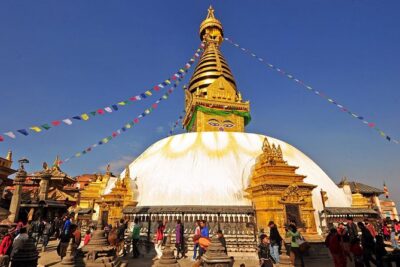
Private Kathmandu Sightseeing Tour | UNESCO World Heritage sites
Read our review →
Full Day 7 UNESCO Tour with Lunch – Private/Group
Read our review →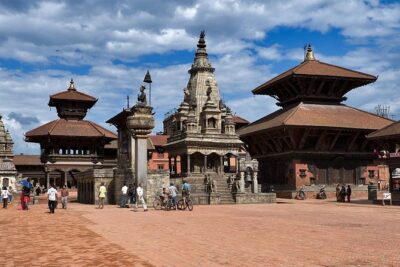
Private Bhaktapur and Nagarkot Day Tour From Kathmandu
Read our review →
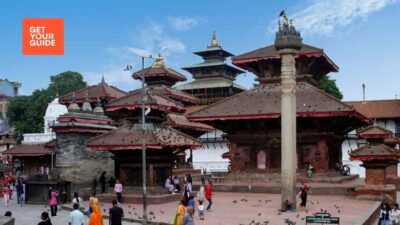
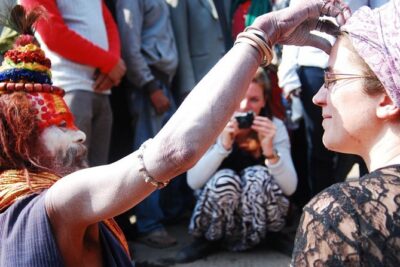
Kathmandu Spiritual Sites: Bodhnath & Pashupatinath Tour
Read our review →
Day Trip to Bhaktapur and Panauti from Kathmandu
Read our review →
Browse the lists this tour appears in