Reviewed · TOURS IN KATHMANDU
Kathmandu Full Day Tour
Kathmandu’s biggest sights are spread across the valley, but this tour brings four major stops into one workable day: Kathmandu Durbar Square, Swayambhunath, Pashupatinath, and Boudhanath. You get royal courtyards, Buddhist prayer traditions, Hindu worship, and one of Nepal’s most important cremation sites without having to arrange several taxis.
I like the hotel pickup and drop-off, especially on a first day when Kathmandu traffic and unfamiliar streets can make a meeting point a chore. I also like the guides who bring more than dates and building names to the day. Birodh Burlakoti, mentioned by name in several comments, is praised for his English, easy manner, local knowledge, and eye for good photographs.
The trade-off is pace. Six hours is enough for a strong introduction, not a leisurely study of each monument. Entrance fees, roughly NPR 2,600 per person, and lunch are extra, and one account describes a serious delay when the vehicle broke down. Ask about transport condition before setting out.
Key points to know before booking
- Four major sites in about six hours: The route covers two Buddhist landmarks, two Hindu or royal heritage sites, and several UNESCO-listed areas.
- Hotel transfers simplify your first day: Pickup and return to your hotel remove the need to find a central meeting point.
- Birodh Burlakoti is a guide to request: His clear English, friendly style, site knowledge, and photography help receive repeated praise.
- The entry fees are not included: Budget about NPR 2,600 per person for the UNESCO and religious sites.
- This is a small-group tour with a limit of 30: The actual group may be smaller, but the advertised maximum is not a private-tour guarantee.
- Plan for a brisk visit: Each stop is scheduled for about one hour, with driving between them and no lunch included.
Why this makes a useful first day in Kathmandu
Kathmandu can feel like several cities pressed together. Royal courtyards sit close to shrines, prayer flags, traffic, incense, and daily commerce. If you try to arrange these four places alone, you will spend time working out roads and fares instead of looking around.
This tour gives you a clear cultural frame. At Kathmandu Durbar Square, you see the old royal center. At Swayambhunath and Boudhanath, you encounter Nepali and Tibetan Buddhist traditions. At Pashupatinath, you visit the valley’s most important Hindu temple complex devoted to Shiva.
The guide is a major part of the value. The best feedback focuses on explanations that make the monuments feel connected rather than interchangeable. That matters in Kathmandu, where a visitor can easily reach temple fatigue after the third courtyard. A good guide explains why a shrine matters, how people use it, and what details deserve your attention.
The tour normally lasts about six hours. Four stops are allocated roughly one hour each, so the remaining time covers hotel pickups, road travel, and movement between sites. Traffic can be slow, and the tour should be treated as an orientation day rather than an exhaustive cultural program.
A few more things to do in Kathmandu worth a look
- Kathmandu: Full Day 7 UNESCO Tour with Lunch – Private/Group
★ 5.0 · 415 reviews - Kathmandu: Full Day Top 4 UNESCO Tour with Lunch – Private/Group
★ 5.0 · 269 reviews - Kathmandu: Full-Day 7 UNESCO Tour with Lunch – Private/Group
★ 4.9 · 247 reviews
Kathmandu Durbar Square and the old royal center
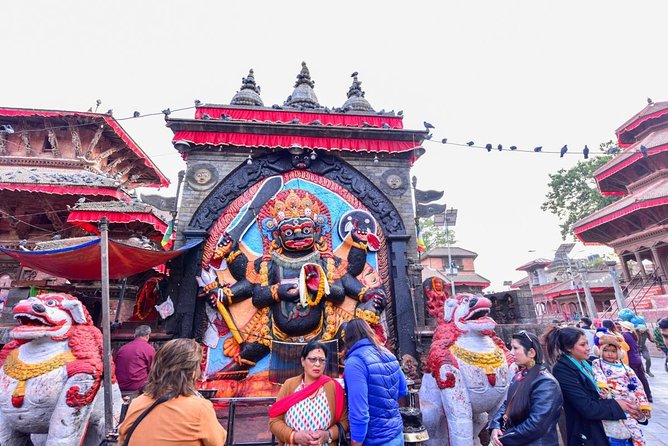
Kathmandu Durbar Square sits in the heart of old Kathmandu at Basantapur. It is also called Hanuman Dhoka Square, after the old royal palace complex. The appeal is not one single building. It is the cluster of palaces, courtyards, temples, and carved architectural details gathered around the former seat of power.
Give yourself time to look up and around. Kathmandu’s traditional buildings reward close attention, especially in the timberwork and the arrangement of the courtyards. Your guide can help separate the important royal and religious spaces from the many smaller structures that may otherwise blur together.
The site suffered serious damage in the April and May 2015 earthquakes. Restoration and damage remain part of what you see, so do not expect every building to look untouched or complete. That may be disappointing if you want a perfectly preserved palace square, but it also gives the visit an honest connection to Kathmandu’s recent past.
One hour is a sensible introduction here. It lets you see the main area and hear the background without using most of the day at the first stop. If old architecture is your main interest, you may wish you had more time. If this is your first visit, the short stop keeps the day moving.
The entry charge is not included. The supplied information gives an estimated total of about NPR 2,600 per person for entrance to the UNESCO sites on the tour, rather than a separate price for each location. Bring extra Nepalese rupees or confirm the current payment arrangement before departure.
Swayambhunath, the hilltop Buddhist shrine
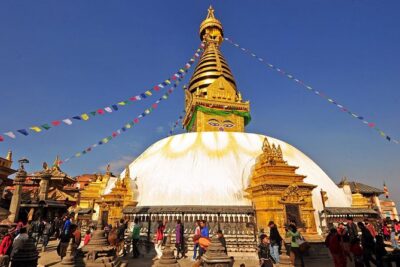
Swayambhunath is the Tibetan Buddhist stupa included on the route. It is often associated with the nickname Monkey Temple, but the religious setting deserves more attention than the nickname. You are there to see a major Buddhist monument and learn about Nepali and Tibetan Buddhist practice.
The stop is listed as about one hour. That is enough for the main visit, though the experience may feel quick if you want to study every shrine or spend time taking photographs. Your guide’s explanations are useful here because the symbols around a stupa can be difficult to understand at a glance.
The location also adds a different feel from the royal square. Instead of palace courtyards, you get a Buddhist pilgrimage setting with a strong sense of ritual and visual symbolism. The tour’s value is not only in checking off another famous place. It is in helping you see how Buddhism fits into Kathmandu’s religious life alongside Hindu worship.
Wear practical shoes and expect an active sightseeing stop. The tour data does not give a detailed description of the route or steps, so you should ask the operator if you have mobility concerns. Most people can participate, but the general participation note is not a promise of step-free access.
Pashupatinath and the living Hindu tradition
Pashupatinath Temple is devoted to Lord Shiva and is one of the most important Shiva sites in Asia. The complex dates back to the fifth century, with later work by Malla rulers. It is not simply an old monument for photographs. It remains a major religious place.
That distinction is important. You will be visiting a functioning Hindu sacred site, not an empty museum. A guide can explain the role of the temple, the importance of Shiva, and the customs you are seeing. This context helps you observe respectfully and avoid treating religious activity as a performance arranged for sightseeing.
The stop lasts about an hour. That gives you time for an introduction and a look at the principal areas included in the visit. It may not satisfy anyone hoping to explore every corner of a large temple complex, but it fits the tour’s larger purpose: showing you the main religious traditions of Kathmandu in a single day.
This is one place where the guide’s manner matters greatly. Clear explanations and a respectful tone help you understand what is happening without reducing it to a list of exotic sights. Several highly rated accounts single out guides who were able to explain history and cultural meaning in accessible English.
As with the other sites, admission is extra. The supplied information does not specify separate ticket rules or access restrictions for particular sections, so follow your guide’s instructions on where you may enter and what you may photograph.
Same base, a different kind of day:
- Everest Base Camp Trek – 14 Days
★ 5.0 · 1,499 reviews - Private Kathmandu Sightseeing Tour | UNESCO World Heritage sites
★ 5.0 · 756 reviews - Everest Base Camp Helicopter Tour landing at Everest View Hotel
★ 5.0 · 668 reviews - Half day cooking class in Thamel kathmandu
★ 5.0 · 607 reviews
Boudhanath, the day’s grand Buddhist finale
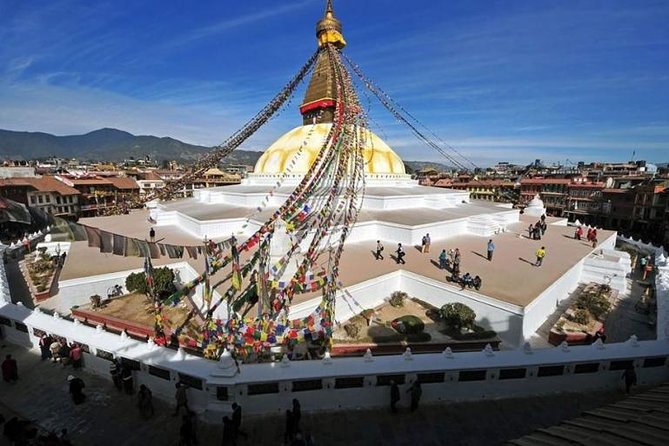
Boudhanath, also written as Bouddhanath, is about eight kilometers east of downtown Kathmandu. Its 36-meter-high stupa is one of the largest in the Kathmandu Valley and gives the tour a powerful final stop.
The scale changes the mood. After the compact courtyards of the royal square and the hilltop setting of Swayambhunath, Boudhanath feels broad and monumental. The stupa is the focus, but the surrounding Buddhist setting gives you more to notice: prayer activity, religious symbols, and the way the monument functions as part of a living community.
You have about an hour here. That is enough to take in the main structure and listen to your guide, but it may pass quickly if you want to sit, walk around more than once, or stop for lunch. Lunch is not included, although one account describes eating above the stupa. Treat that as an optional stop, not part of the stated package.
Boudhanath is also a good place to ask questions. By this point, you have seen two Buddhist sites and two Hindu or royal landmarks. A capable guide can help you compare the traditions without flattening them into the same general idea of spirituality.
The guide can make or break the day
The strongest part of this experience is the human explanation. Several comments single out Birodh Burlakoti for being courteous, funny, informed, and helpful with photographs. One first-day visitor also found that his practical help made arriving in a new city feel less stressful.
Another comment praises a guide called Deep for excellent English and explanations that gave each temple its own meaning. The useful lesson is simple: ask who your assigned guide will be, and if possible request Birodh or another guide with strong English.
Language ability matters here because names, religious terms, and historical details can be hard to follow. One less positive comment warns that unclear pronunciation made it easy to miss details. That is not a small issue on a tour built around explanation.
Guiding style matters, too. One person found the pace too fast and had trouble keeping up. If you need more time for photographs, have limited mobility, or prefer a slow visit, say so at the start. The guide needs to balance a fixed route, traffic, and a group that may contain people with different walking speeds.
Transport, group size, and the real pace
Pickup and return at your hotel are included. That is a practical advantage in Kathmandu, where locating a shared meeting point can waste time and add stress. Pickup may also mean stopping at other hotels, so the day may not begin at the exact moment you leave your own accommodation.
Private transportation is included, but the tour itself is a small-group departure with a maximum of 30 people. Those terms can sound contradictory, so read them as transport arranged by the operator for a group tour, not as a guaranteed private car for only you and your companions.
Vehicle reliability deserves a direct mention. One very poor account describes a breakdown halfway through the day, followed by a walk of more than 30 minutes beside dusty, busy roads in the sun. A single failure does not define every departure, but it is a fair reason to confirm that the vehicle has working air conditioning and that backup arrangements exist.
The schedule is tightly packed. Expect about one hour at each of the four sites, plus road time. You can see the main highlights, but you cannot linger at every courtyard, shop, shrine, and viewpoint.
Is $70 a fair price?
At $70 per person, the tour offers hotel transfers, a local guide, group departure, and private transportation. For a first visit, that bundle can be good value because you are paying for orientation and movement between four far-flung sights, not just admission to a monument.
The advertised price is not the final sightseeing cost. Lunch is excluded, shopping is excluded, and entrance fees are estimated at about NPR 2,600 per person. Add those costs before comparing the tour with hiring a car or arranging separate visits.
The price makes the most sense if you have limited time, want a guide, or do not want to negotiate transport in Kathmandu. It is less attractive if you already know the city, prefer long visits at fewer sites, or are comfortable arranging taxis and paying for your own explanations.
A group of up to 30 can also affect value. You may receive a very good guide but have to stay with a larger party. If you want flexible stops and personal attention, ask about a private option before booking.
Who should book this Kathmandu day tour?
I would recommend it to a first-time visitor with one free day, especially someone arriving without a detailed plan. It gives you four major reference points and enough background to decide where you want to return later.
It also suits people who want hotel pickup, an English-speaking local guide, and one organized route rather than several independent rides. Families can participate, but children must be accompanied by an adult, and the pace may be tiring for younger children.
I would be more cautious if you have mobility limits, want a slow photographic visit, or dislike group schedules. Ask about walking conditions, current site access, vehicle arrangements, and the expected group size before paying.
Free cancellation is available if you cancel at least 24 hours before the start time. Cancellations or changes made within 24 hours are not refunded or accepted, based on the local start time.
Final verdict: a strong orientation, not a deep visit
This is a useful way to meet Kathmandu quickly. You see the old royal center, a hilltop Buddhist shrine, a major Hindu temple complex, and the huge stupa at Boudhanath in one day. The cultural range is the real attraction.
Book it if you want a guided introduction and simple hotel transfers. Pay close attention to the extra entry fees, bring money for lunch, and ask for a guide with clear English. If you receive someone like Birodh Burlakoti, the tour can turn a packed schedule into a clear first lesson in Kathmandu.
Skip it if you want to linger, explore independently, or spend a full morning at one monument. Six hours can show you the city’s essential outline, but it cannot give every site the time it deserves.
FAQ
How long does the Kathmandu Full Day Tour last?
The tour lasts approximately six hours.
Which places does the tour visit?
It visits Swayambhunath, Kathmandu Durbar Square, Boudhanath Stupa, and Pashupatinath Temple.
Is hotel pickup included?
Yes. Pickup from your hotel and drop-off at your hotel are included.
Is transportation included?
Yes. Private transportation is included as part of the organized group departure.
Are entrance fees included in the price?
No. Entrance fees are extra and are estimated at about NPR 2,600 per person.
Is lunch included?
No. Lunch is not included.
What is the maximum group size?
The tour can have a maximum of 30 travelers.
Is a local guide included?
Yes. A local tourist guide is included.
Must children be accompanied by an adult?
Yes. Children must be accompanied by an adult.
Can I cancel for a full refund?
Yes, if you cancel at least 24 hours before the experience start time. Cancellations made within 24 hours are not refunded.
Just added in Kathmandu
- Kathmandu to Chitwan Tour by Tourist Bus – A Convenient and Affordable Way★ 4.0 · 4 reviews
- Changunarayan Hill to Telkot Hike Near Kathmandu Day Tour★ 5.0 · 6 reviews
- Mt Everest Base CampTrek | Budget Package★ 5.0 · 4 reviews
- Chitwan Jungle Safari 3-Day Tour★ 5.0 · 9 reviews
- Chandragiri Hill Station Tour by Cable Car★ 5.0 · 4 reviews
- Chandragiri Hills cable car day trip, private car with driver from Kathmandu★ 5.0 · 8 reviews
- Chandragiri to Taudaha Nature Day Hiking from Kathmandu★ 5.0 · 13 reviews
- Chandragiri Cable Car & Monkey Temple Private Guided Day Tour★ 5.0 · 5 reviews
Tours in Kathmandu, compared.
Private Kathmandu Sightseeing Tour | UNESCO World Heritage sites
Read our review →
Everest Base Camp Helicopter Tour landing at Everest View Hotel
Read our review →
Nagarkot Sunrise View and Day Hiking from Kathmandu
Read our review →
Full Day 7 UNESCO Tour with Lunch – Private/Group
Read our review →