
Reviewed · ANNAPURNA BASE CAMP TREKS
Annapurna base camp -9 days
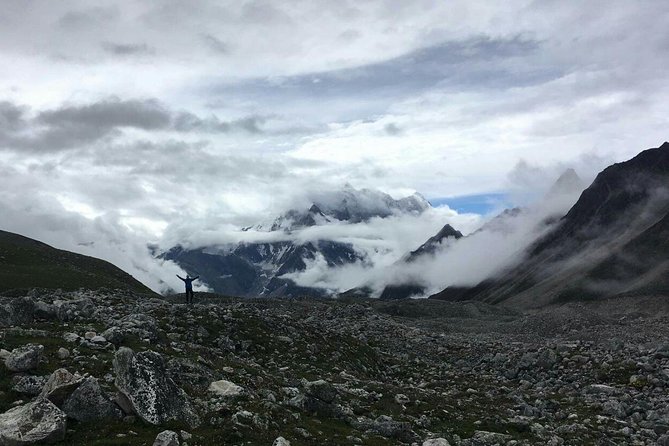
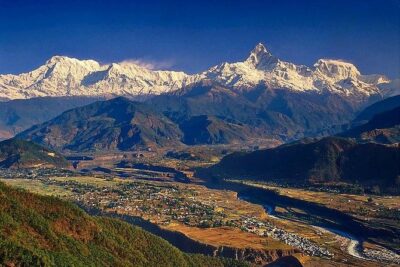
Annapurna Base Camp is the reward at the end of a beautiful, demanding walk through Gurung and Magar villages, rhododendron forest, river valleys, and high mountain country. The route brings you close to Himchuli, Annapurna South, Machhapuchchhre, and the Annapurna range without requiring the length of a major Himalayan expedition.
I like the balance here: nine days gives you time for villages, mountain views, and a hot-spring stop, while the package handles permits, buses, meals, guide support, and basic gear. I also like that it is a private trip, so your group can work with the guide rather than follow a large fixed crowd. The main caution is that the schedule is physically serious, with long uphill and downhill sections, and the published first-day details are unclear, so confirm the exact arrival and trekking plan before paying.
Key points to know before booking
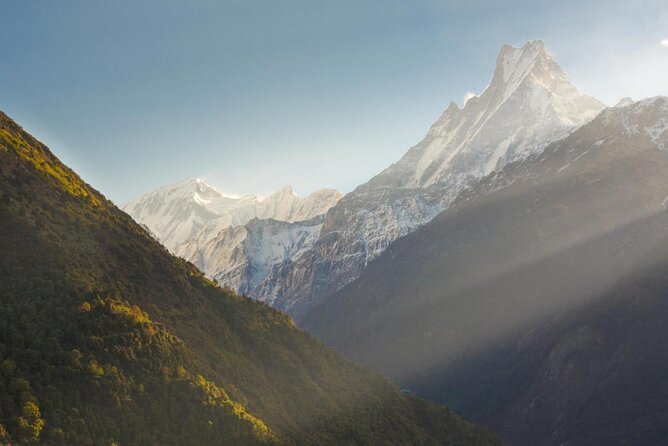
- The route reaches Annapurna Base Camp after Machhapuchhre Base Camp, entering the high, treeless Annapurna Sanctuary.
- Daily walking times run from about four to six hours, with stone steps, steep descents, and repeated climbs.
- The package includes a licensed English-speaking guide, permits, meals, transport, a sleeping bag, and a down jacket.
- Jhinu is a welcome pause, with natural hot springs available near the end of the trek.
- The trip is private, making it easier to adjust the pace or itinerary with your guide.
- A porter costs an extra $220 per person, and personal costs such as showers, laundry, drinks, tips, and emergency evacuation are separate.
Why the Annapurna Base Camp route is worth your legs
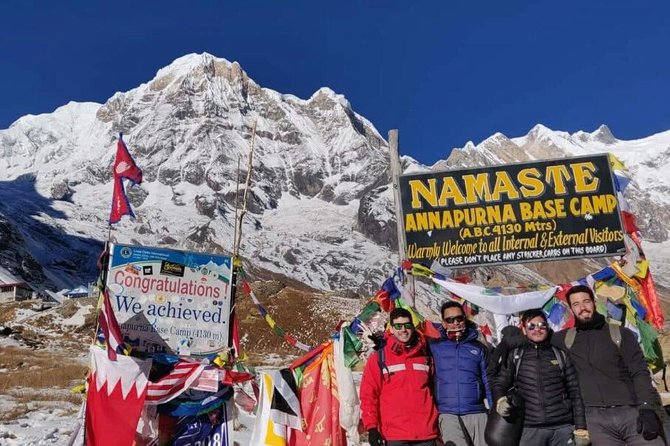
The appeal of this trek is its changing scenery. You begin among cultivated hills and traditional villages, then move through thick forest and river valleys before reaching a stark high-altitude basin surrounded by snowy peaks.
That variety matters. You are not walking through the same type of country for nine days. One morning may bring terraced fields and village paths. Later, the trail follows the Modi Khola River beneath cliffs and forest. Near base camp, trees disappear and the route feels much more exposed and remote.
The cultural side is just as useful as the mountain views. Dhampus, Landrung, Chhomrong, and other settlements are associated with Gurung and Magar communities, and the route passes through villages rather than keeping you away from daily life. You should expect simple accommodation and mountain teahouse meals, not resort comfort.
The area is also valued for its plants and wildlife. The wider Annapurna region supports rhododendron forest, many bird species, butterflies, and high-country animals such as blue sheep. Sightings are never guaranteed, but the natural setting changes noticeably as you climb.
Other Annapurna routes from Kathmandu:
- Annapurna base camp trek 5 Days
★ 5.0 · 252 reviews - Annapurna Base Camp Trek
★ 5.0 · 111 reviews - Kathmandu to Annapurna Base Camp (ABC) 5-Day Trek
★ 5.0 · 102 reviews
Day 1: airport pickup and the schedule to confirm
The trip begins with pickup at Tribhuvan International Airport in Kathmandu at the stated 6:30 am start time. A private vehicle transfers you to your hotel, and airport drop-off is also included later.
There is a small but important scheduling wrinkle. The published program labels Day 1 as Poon Hill and gives it six hours, yet it also says the package starts on the second day after arrival. The later itinerary begins with a drive from Pokhara to Phedi. Ask the operator to confirm whether Poon Hill is actually part of your nine trekking days or simply a misplaced itinerary label.
This matters because Poon Hill is not a minor side stop. It is a separate viewpoint trek, and adding it can affect your rest, transport, and walking schedule. Get the final plan in writing, especially if you are arriving after a long international flight.
Transportation between Kathmandu and Pokhara is by tourist bus, with a flight available at an extra cost. The bus keeps the listed price lower, while the flight may save time. Since transport time can affect how rested you feel before the trek, ask which option has been assigned and what the additional flight charge will be.
Day 2: Phedi to Dhampus and the first mountain views
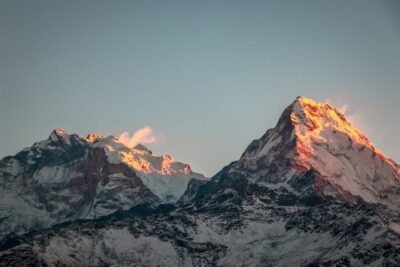
The main walking route begins at Phedi, reached from Pokhara. From there, you climb toward Dhampus, a pleasant Gurung village with views toward Himchuli, Annapurna South, and Machhapuchchhre, also called Fishtail.
This is a good first walking day because it introduces the trail without sending you straight into the highest country. The listed walking time is about four hours, enough to get your legs working while still leaving time to enjoy the village and views.
The practical warning is simple: even an easy-sounding first day includes climbing. You should arrive with sturdy walking shoes, a small daypack, water, and enough flexibility to move at the guide’s pace. The route is not presented as a casual sightseeing walk.
Day 3: Landrung, Jhinudanda, and village country
The trail heads through oak forest and terraced fields toward Landrung. This village is described as home to Gurung, Magar, and Brahmin communities, giving the day a wider cultural mix than a route focused only on mountain scenery.
The path then continues down toward Jhinudanda. The five-hour schedule sounds manageable, but downhill walking can be hard on knees, especially after the first day of trekking. Trekking poles would be useful, though they are not listed as included equipment.
I like this part of the route because it gives you a sense of how people live in the middle hills. You are not simply being carried from viewpoint to viewpoint. The villages, fields, and forest make the approach to base camp feel earned.
Same base, a different kind of day:
- Everest Base Camp Trek – 14 Days
★ 5.0 · 1,499 reviews - Private Kathmandu Sightseeing Tour | UNESCO World Heritage sites
★ 5.0 · 756 reviews - Everest Base Camp Helicopter Tour landing at Everest View Hotel
★ 5.0 · 668 reviews - Half day cooking class in Thamel kathmandu
★ 5.0 · 607 reviews
Day 4: Sinuwa, Khuldighar, and long stone steps
From Chhomrong, the trail crosses a bridge and climbs to Sinuwa Danda. It then cuts through thick rhododendron forest toward Khuldighar before descending on long, steep stone steps.
This is one of the days to take seriously. The listed duration is about five hours, but the difficulty comes from the repeated change between climbing and descending. Stone steps can be tiring even when the total walking time looks moderate.
The rhododendron forest is one of the route’s visual highlights. The forest also gives shade, although wet or uneven steps can slow you down. Stay close enough to your guide to keep the route clear, and do not judge the day only by distance.
Day 5: Machhapuchhre Base Camp and the sacred valley
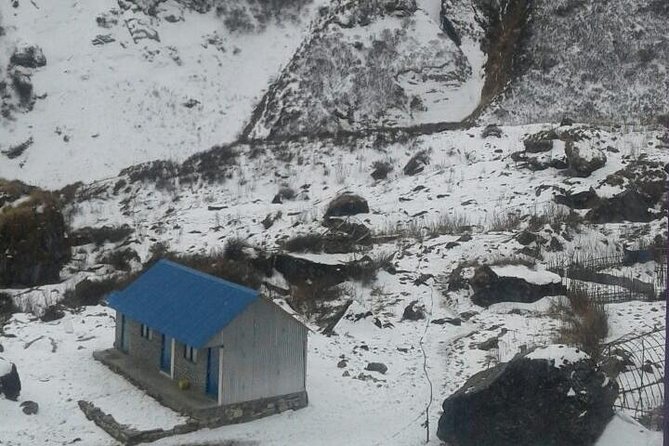
The route follows the Madi River through a sacred valley, with a gradual ascent toward Machhapuchhre Base Camp. The trail passes bamboo and continues into higher country, where the environment becomes cooler and less wooded.
One notable rule applies here: no meat or fish is allowed in this area because of local Buddhist and Hindu beliefs. That is more than a meal-planning detail. It reflects the religious meaning attached to the valley, and you should respect the restriction rather than treat it as an inconvenience.
The walk is listed at six hours. At this point, you are gaining altitude and spending more time in exposed country, so pacing becomes important. Your guide will be central to setting a sensible rhythm and deciding how much time to spend at stops.
Machhapuchhre Base Camp is not the final destination, but it is a major point in the trek. From here, vegetation fades and the scenery takes on a spare, high-mountain character.
Day 6: entering the Annapurna Sanctuary and reaching base camp
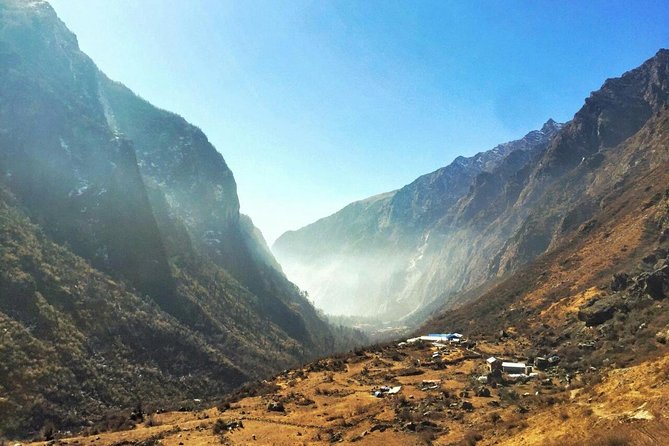
After leaving Machhapuchhre Base Camp, the route enters the Annapurna Sanctuary, a high basin surrounded by major peaks. Trees give way to a desert-like wilderness, and the feeling changes from forest trekking to open mountain travel.
The day is listed at about five hours, though the altitude can make that time feel longer. You are heading toward the main goal, but this is not the moment to rush. The value of the guide is practical here: keeping the pace steady, monitoring how you are coping, and helping with the route and accommodation.
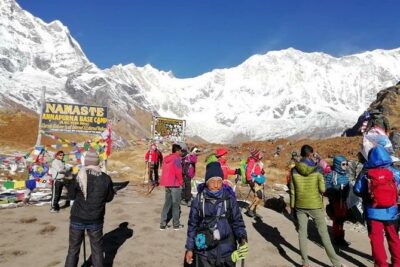
At Annapurna Base Camp, the setting is the payoff. You are surrounded by the Annapurna range, with the earlier views of Himchuli, Annapurna South, and Machhapuchchhre now part of a much broader mountain scene.
The base camp itself is not presented as a luxury facility. Expect basic mountain accommodation and limited personal comforts. The package includes breakfast, lunch, and dinner, but hot showers, drinks, snacks, phone use, and similar extras are your responsibility.
Day 7: sunrise at Annapurna Base Camp and descent to Bamboo
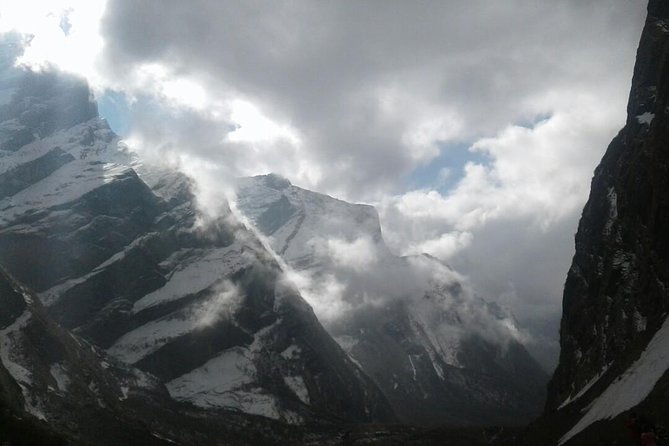
An early wake-up call is planned so you can see sunrise over the Annapurna Sanctuary. This is one of the strongest reasons to stay at base camp rather than hurry away after arrival.
Sunrise in a high basin depends on weather, but the timing gives you the best chance to see the peaks in changing light. Bring warm layers where you can reach them quickly. The supplied down jacket and sleeping bag are returnable after the trek, which is helpful in this cold section.
After breakfast, you descend along the Modi Khola River toward Bamboo Hut. The walking time is about six hours. Downhill walking may seem easier after reaching the goal, but the long descent can put real pressure on your knees and toes.
The change in scenery is satisfying. You leave the treeless sanctuary and gradually return toward forest and river country. Keep some energy in reserve, since a descent of this length is not a gentle stroll.
Day 8: Chhomrong, Jhinu, and the natural hot springs
The day begins with an uphill walk to Sinuwa, followed by a descent to the Chomrong Khola River. Another climb takes you to Chhomrong before the final descent to Jhinu.
This up-and-down pattern is typical of Himalayan routes. The listed walking time is about six hours, and the repeated climbs can feel harder than a single steady ascent. Your guide can help you manage the pace, but you should still expect a demanding day.
Jhinu is the day’s pleasant reward. You can visit the natural hot springs near the village, making this a useful place to relax tired legs before the final walk out.
One past arrangement changed the trek to eight days to fit a traveler’s schedule and allowed an extra night at the hot springs. That suggests some flexibility may be possible, but do not assume changes are automatic. Discuss any alteration before departure, and ask about extra accommodation or transport costs.
Day 9: Nayapul, Pokhara, and the end of the trail
The final walking day follows an easy descent toward the Modi Khola River and continues to Nayapul. From there, a private car takes you back to Pokhara in about one and a half hours before your hotel transfer.
The walking time is listed at five hours, so this is not just a quick exit. Still, after the high sections and repeated climbs, the easier descent should feel like a proper finish.
The package states that transport continues between Pokhara and Kathmandu by tourist bus, although the day-by-day description focuses on the drive back to Pokhara. Confirm where your nine-day service ends and how the final Kathmandu transfer is arranged. The package also includes airport transfer, but food and accommodation in Kathmandu are not included.
What the $693.34 price really covers
At $693.34 per person, the price has useful coverage for a private Himalayan trek. It includes a licensed English-speaking guide, guide transport, food, accommodation, insurance, a first-aid kit, permits, required paperwork, airport transfers, Kathmandu to Pokhara transport, and the return journey.
You also receive nine breakfasts, nine lunches, and nine dinners, plus a returnable down jacket and sleeping bag. A welcome or farewell dinner in Kathmandu at a cultural restaurant is included as well.
The biggest extra is the porter, listed at $220 per person. Personal insurance is not included, and you must also pay for international airfare, visa charges, shopping, bar bills, hot showers, telephone use, laundry, snacks, tips, and emergency costs such as a chartered helicopter.
That last category deserves attention. Travel insurance with trekking and emergency evacuation cover is essential, even though it is not part of the package. A low headline price is useful only if you budget for the costs that appear during a nine-day mountain trip.
Guides, private trekking, and the level of support
This is a private activity, so only your group takes part. That gives you more room to discuss pace, rest stops, and small itinerary changes than you would have in a large group.
Several guides and porters have been associated with this trek, including Binod, Sona, Rajendra, Bikash, and Rahul. The exact team is not guaranteed, so ask for the names before departure if that matters to you. The strongest praise has centered on friendly, attentive support, with solo walkers receiving close care and some groups enjoying easy conversation and humor along the trail.
The guide is also responsible for carrying a first-aid kit and handling permits and paperwork. That reduces the amount you need to organize, but it does not replace your own medical preparation or insurance.
Who should book this trek
I would choose this trek if you want a classic Annapurna route with village life, mountain views, and a clear base camp goal, but you do not want to organize every permit, meal, bus ride, and teahouse yourself.
It suits people with a moderate fitness level who are comfortable walking four to six hours a day and handling steep stone steps. It can work for solo participants, couples, families with suitable fitness, or a small private group.
I would hesitate if you want polished hotels, reliable hot showers, short walking days, or a fully fixed schedule with no ambiguity. I would also think twice if you have knee problems or limited experience with long descents, unless you have professional medical advice and a realistic plan.
Should you book the Annapurna Base Camp trek?
Book it if the combination of private guiding, included meals and permits, village stays, and a nine-day route to Annapurna Base Camp fits your travel style. The package gives you a practical framework and has shown flexibility with timing and guide support.
Before booking, confirm the first-day Poon Hill reference, the exact number of nights covered, the Kathmandu accommodation gap, the transport schedule, the porter fee, and the guide assignment. If those details are clear and you are ready for long climbs and descents, this is a strong-value way to experience the Annapurna Sanctuary without managing the trip alone.
FAQ
Where does the Annapurna Base Camp trek start?
The listed trekking route starts at Phedi after transport from Pokhara. The full service begins with airport pickup at Tribhuvan International Airport in Kathmandu.
How long does the trek take?
The experience is planned for nine days. The daily walking sections are generally listed at four to six hours.
Is transportation from Kathmandu to Pokhara included?
Yes. Tourist bus transportation from Kathmandu to Pokhara and back to Kathmandu is included. An optional flight is available at an extra cost.
Are meals included?
Yes. The package includes nine breakfasts, nine lunches, and nine dinners. Personal extras such as drinks, snacks, bar bills, and some food in Kathmandu are not included.
Is a porter included?
No. A porter is listed as an additional $220 per person. The package does include a licensed English-speaking trekking guide.
What equipment is supplied?
A returnable down jacket and sleeping bag are supplied. The guide also carries a first-aid medical kit.
Can I cancel for a full refund?
Yes, if you cancel at least 24 hours before the local start time. Cancellations or changes made less than 24 hours before the start are not accepted for a refund.
Just added in Kathmandu
- Kathmandu to Chitwan Tour by Tourist Bus – A Convenient and Affordable Way★ 4.0 · 4 reviews
- Changunarayan Hill to Telkot Hike Near Kathmandu Day Tour★ 5.0 · 6 reviews
- Mt Everest Base CampTrek | Budget Package★ 5.0 · 4 reviews
- Chitwan Jungle Safari 3-Day Tour★ 5.0 · 9 reviews
- Chandragiri Hill Station Tour by Cable Car★ 5.0 · 4 reviews
- Chandragiri Hills cable car day trip, private car with driver from Kathmandu★ 5.0 · 8 reviews
- Chandragiri to Taudaha Nature Day Hiking from Kathmandu★ 5.0 · 13 reviews
- Chandragiri Hill Day Tour★ 5.0 · 4 reviews
Annapurna Base Camp Treks, compared.
Kathmandu to Annapurna Base Camp (ABC) 5-Day Trek
Read our review →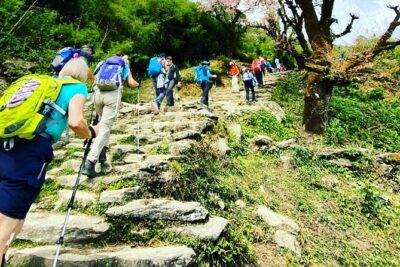
11-Day Hike Tour to Annapurna Base Camp Bliss in Kathmandu
Read our review →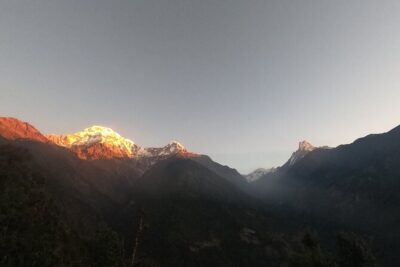
Browse the lists this tour appears in