
Reviewed · EVEREST BASE CAMP TREKS
Gokyo to Everest Base Camp Trek
Gokyo to Everest Base Camp is the long way to Everest, and that is exactly why it earns its keep. You first reach the turquoise Gokyo Lakes, climb Gokyo Ri at 5,483 meters, then cross the icy Cho La Pass before joining the famous trail to Base Camp. It is a proper Himalayan circuit, not simply an out-and-back walk to Everest.
I like two things right away. First, Gokyo gives you a quieter start and superb views of Cho Oyu, Everest, and Makalu. Second, the package takes care of the costly moving parts: airport transfers, Lukla flights, permits, guides, porters, meals, filtered trail water, and mountain lodging. The catch is clear: this is a hard trek with thin air, basic rooms near Cho La, early starts, and weather that can change the plan.
Key points to know before booking
- Gokyo Lakes add a quieter western route before you reach the crowded Everest Base Camp corridor.
- Cho La Pass at 5,300 meters is the trek’s crux, with a pre-dawn start to reduce weather risk.
- Gokyo Ri and Kala Patthar provide two major viewpoints, each demanding a steep climb at high altitude.
- The $2,200 price covers major essentials, including Kathmandu hotels, domestic flights, food, permits, guides, porters, and equipment loans.
- Small groups are capped at 15 people, with one porter assigned for every two clients.
- Guides have shown flexibility in bad weather, with Nima, Raj Kumar, Ramesh, Biroj, Ganesh, Sonam, and Lakpa Sherpa praised for care and safety-minded decisions.
Why the Gokyo route is worth the extra effort
The standard Everest Base Camp route is famous. The Gokyo route gives you more variety. You walk through the Dudh Koshi valley, pass Sherpa settlements, reach the Gokyo Lakes, cross a high mountain pass, and then approach Everest from the west.
That change matters. The Gokyo section brings you to the source area of the Dudh Koshi and the Ngozumpa Glacier, with broad mountain views and fewer groups than the main trail. You also get two distinct summit-like moments: Gokyo Ri and Kala Patthar.
The trade-off is extra effort. You spend 17 days at altitude, and several days involve long walking hours. This is not a casual sightseeing holiday with a few scenic walks added on. You need a moderate fitness level, patience, and enough flexibility to accept changes caused by snow, storms, or flight delays.
Other treks that start from Kathmandu:
- Everest Base Camp Trek – 14 Days
★ 5.0 · 1,499 reviews - Everest Base Camp Helicopter Tour landing at Everest View Hotel
★ 5.0 · 668 reviews - Everest Base Camp Trekking
★ 5.0 · 485 reviews
Kathmandu, Lukla, and the first mountain views
Your trip begins at Tribhuvan International Airport, where an Ace the Himalaya representative meets you and transfers you to your hotel. Two nights in Kathmandu are included, one at the beginning and one after the trek.
The mountain part begins with a 35-minute flight from Kathmandu to Lukla, landing at Tenzing and Hillary Airport at 2,804 meters. The flight is short, but it is a major part of the trip because Lukla is the gateway to the Khumbu region.
From Lukla, you walk to Phakding. This first trekking day can last much of the day, with the route following the Dudh Koshi and passing through small mountain settlements. It is a useful introduction to the pace of the trek, but do not treat it as a throwaway warm-up. You are already gaining altitude and carrying the first day’s fatigue.
Accommodation is in mountain guesthouses. Rooms are shared by two people when possible, with attached toilets listed for Lukla, Phakding, and Namche. Conditions become more basic farther out, so bring realistic expectations about comfort.
Namche Bazaar gives you time to adjust
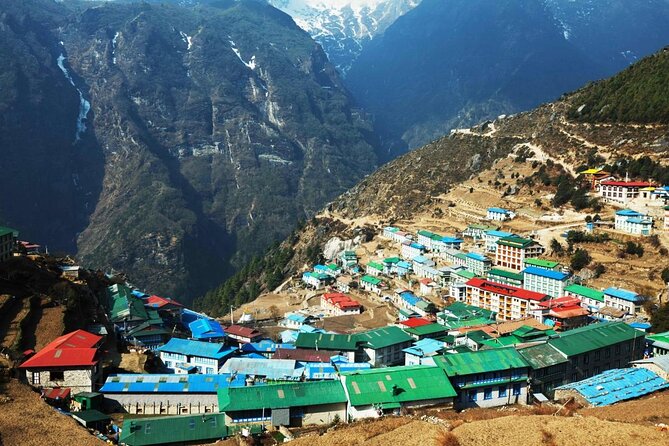
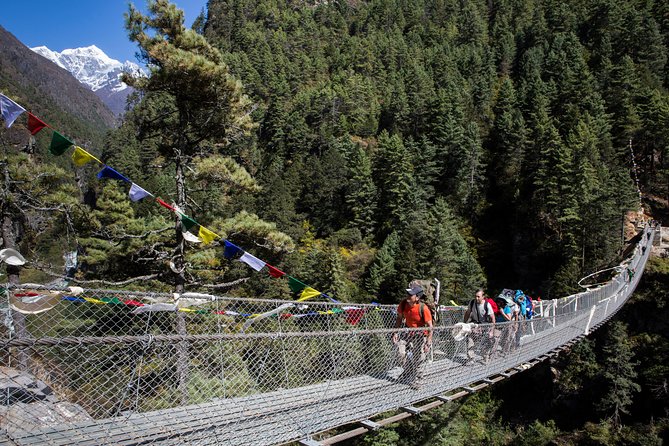
The route continues along the Dudh Koshi, crossing suspension bridges decorated with prayer flags before entering Sagarmatha National Park. The trail then climbs toward Namche Bazaar, the best-known town in the Khumbu region.
Namche is important for more than its shops and views. It is your first major acclimatization stop. The itinerary includes a full day here, with a short walk to a museum focused on Sherpa customs and the local mountain culture.
That rest day is not wasted time. At altitude, rushing usually costs more than it saves. You need the pause to let your body adjust before the trail climbs higher. The itinerary uses a gradual approach, but the route still moves from Lukla at 2,804 meters to much higher camps in only a few days.
The walking day into Namche and the acclimatization day are both listed as long itinerary blocks, so ask your guide for the exact walking schedule. The overall plan is clear, but mountain days depend on pace, weather, and group condition.
Phortse and Machhermo bring bigger views
After Namche, the route climbs through rhododendron forest toward Phortse. Juniper and conifers appear as the elevation rises, and the vegetation becomes more open and alpine.
Phortse is a worthwhile stop because it keeps you on a less direct route toward Gokyo. You are not simply repeating the main Base Camp trail. The path passes Yak Kharka and opens views toward Kengtega and Cho Oyu.
The next stage reaches Machhermo. You climb a ridge with views both down toward Kengtega and up toward Cho Oyu, then cross toward the terminal moraine of the Ngozumpa Glacier.
This section is physically demanding in a quiet way. There may be no single dramatic climb like Cho La, but the altitude keeps rising and the trail can feel slow. You should walk steadily, drink the filtered water supplied on the route, and tell your guide early if you feel unwell.
A few more things to do in Kathmandu worth a look
- Nagarkot Sunrise View and Day Hiking from Kathmandu
★ 5.0 · 471 reviews - Annapurna Circuit Trek with Tilicho Lake
★ 5.0 · 368 reviews - Everest Base Camp Trekking – 13 Day
★ 5.0 · 365 reviews - Everest Base Camp Trek -14 Days
★ 5.0 · 321 reviews
Gokyo Lakes and the climb to Gokyo Ri
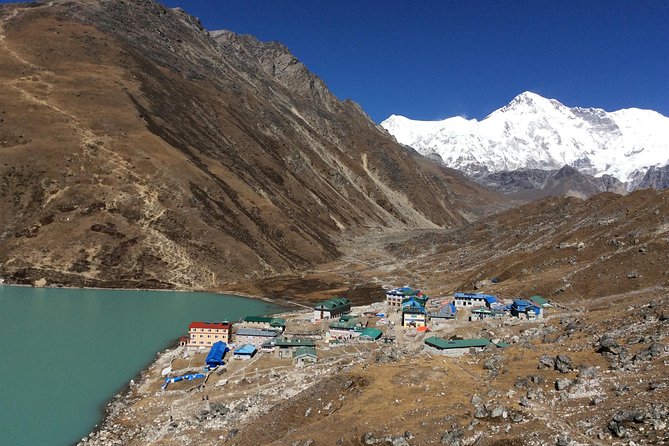
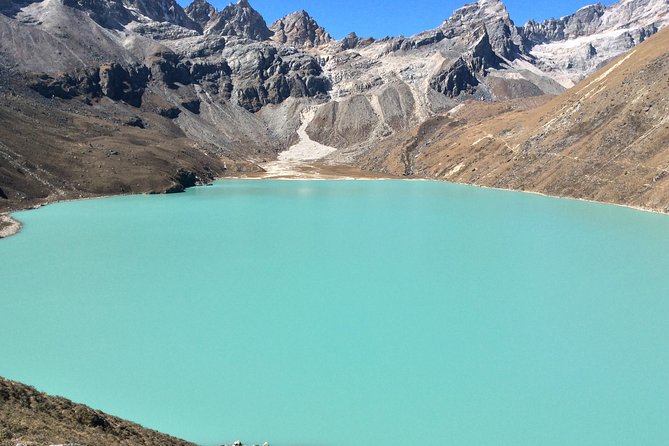
Gokyo sits at about 4,790 meters and becomes your base for two nights. The lakes are the visual reward for taking this western route. You have time to look around rather than arrive, eat, sleep, and leave immediately.
The following morning brings the climb to Gokyo Ri at 5,483 meters. It is steep, and the short distance does not mean an easy outing. At this altitude, every slope takes time.
The reward is a wide mountain panorama over the Gokyo valley, with views toward Cho Oyu, Everest, and Makalu. This is one of the strongest reasons to choose this route. Gokyo Ri gives you a high viewpoint before Everest Base Camp, and the view feels different from Kala Patthar later in the trek.
You should consider the Gokyo Ri climb optional in practical terms, even though it is built into the itinerary. A guide can help you judge your condition, but you should not force the climb if altitude symptoms appear. The point of the trek is to reach the major places safely, not to collect every high point at any cost.
Thangnak and the hard crossing of Cho La
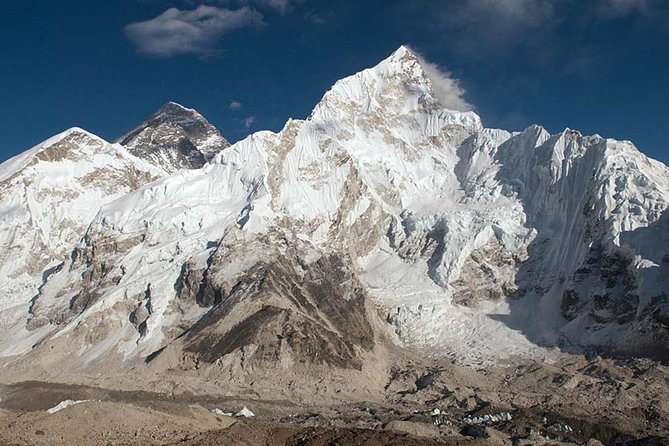
From Gokyo, you walk toward Thangnak, also known as Dragnag in some route descriptions, at the foot of Cho La. This is a remote stop, and the accommodation is specifically described as very basic, with dormitory-style rooms.
That detail matters. You should expect less privacy and fewer comforts here than in Kathmandu or Namche. It is part of the price of taking the high pass route.
The Cho La crossing begins around 4:00 or 5:00 in the morning. The aim is to reach the pass between 9:00 and 10:00, before afternoon weather becomes a bigger problem. You climb to about 5,300 meters and cross difficult high ground before descending toward the Everest side.
This is the trek’s biggest test. Snow and ice can affect the crossing, and conditions can change quickly. The experience provider has shown a safety-first approach when storms or heavy snow affect the route. That flexibility is valuable here, since a fixed timetable matters less than making a sound decision on the day.
A guide such as Nima, Raj Kumar, Ganesh, or Lakpa Sherpa may need to adjust timing or route choices according to conditions. The particular guide assigned to your departure can vary, so do not book based on one name alone. Do book with the expectation that good judgment matters more than simply pushing ahead.
Lobuche and the approach to Everest Base Camp
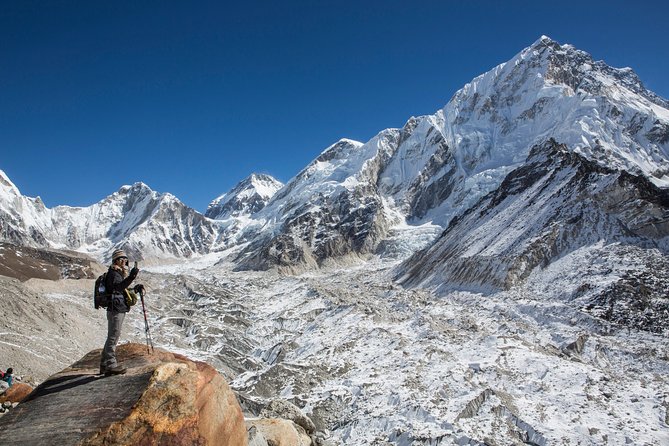
After Cho La, the trail reaches Lobuche by a shorter and easier walking day of about four hours. That relative pause is welcome after the pass.
The next day is the major approach to Everest Base Camp. You walk along the Khumbu Glacier and climb to Base Camp at 5,365 meters. The route is long and difficult, with altitude making every section harder than the distance suggests.
Everest Base Camp is the closest point to Mount Everest on this trek without mountaineering equipment. During spring, you may see expedition activity at the camp, though the exact scene depends on the climbing season and conditions.
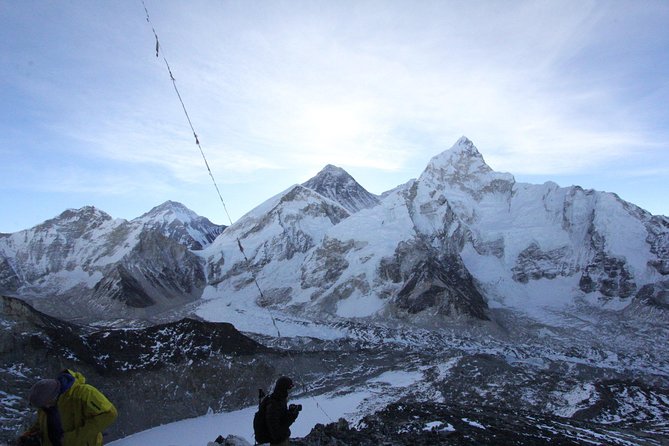
It is worth keeping expectations in check. Base Camp itself is not the finest viewpoint of Everest. The glacier, surrounding peaks, and the meaning of reaching the site are the main rewards. For the clearest broad view of Everest, Kala Patthar is the stronger stop.
Kala Patthar supplies the big Everest view
The climb to Kala Patthar at 5,555 meters is one of the hardest and most rewarding parts of the route. You spend much of the morning climbing a small summit above Gorak Shep and the Base Camp area.
The ascent is demanding because it comes after days of walking and immediately after the Base Camp approach. At this point, your legs are tired and the air is thin. The payoff is a closer, more direct view of Everest and the surrounding peaks.
This is the moment many people picture when they imagine an Everest trek: a high ridge, enormous peaks, and a long trail behind you. Still, you need to handle the climb at your own pace. A strong guide will watch the group and help you make sensible choices if you are struggling.
The return through Tengboche and Namche
After Kala Patthar, the itinerary turns back through Pangboche and Tengboche before reaching Namche. The descent is easier on the lungs, but it still puts stress on knees and feet.
Tengboche is known for its Buddhist monastery, and the route gives you a chance to see Himalayan religious life at high altitude. The monasteries along this trek are not decorative stops added for tourists. They are part of the Sherpa communities you pass through, so behave respectfully and follow your guide’s advice about entry and photography.
Reaching Namche again feels like a practical comfort. You have lower elevation, more services, and a familiar stop before the final walk to Lukla. The next day takes you through the route’s mountain villages and back to the airport town.
What the $2,200 price really covers
At $2,200 per person, this is not a cheap walking holiday, but the package includes many costs that can otherwise add up quickly.
You receive airport transfers, two nights in a three-star Kathmandu hotel, 14 nights in mountain guesthouses, Kathmandu to Lukla flights, trekking permits, a licensed English-speaking guide, and one porter for every two clients. Meals include 16 breakfasts, 14 lunches, and 14 dinners.
The provider also supplies a down jacket, sleeping bag, duffel or kit bag, sun hat, seasonal fruit, and filtered trail water using a Katadyn Pocket Water Filter. Those inclusions reduce the amount of gear and planning you need to arrange alone.
You still pay for international flights, a Nepal entry visa, Kathmandu lunches and dinners, drinks, personal trekking equipment, insurance, and tips. Travel insurance must cover emergency high-altitude rescue and evacuation. Tipping is expected, so include it in your real budget.
The value is strongest if you want a supported trek. You are paying for logistics, staff, permits, food, flights, and a planned acclimatization structure, not simply a room and a guide. Independent trekkers may spend less, but they take on more planning and risk.
Group size, guides, and changing mountain conditions
The group limit is 15 people. That is small enough to keep the group manageable, though individual walking speeds can still vary widely at altitude.
The strongest part of the operation is its human support. Guides including Nima, Raj Kumar, Ramesh, Ganesh, and Lakpa Sherpa have been singled out for patience, flexibility, care, and safety-focused decisions. Porters such as Biroj, Haym, and Sonam have also been praised for their hard work and good spirit.
Do not expect a rigid schedule to control the Himalayas. Storms have caused snow blizzards, heavy rain, route changes, and even helicopter substitutions on some departures. If weather affects the Lukla flight, Cho La crossing, or return, your guide may need to revise the plan.
The experience has a full refund policy when the operator cancels because of poor weather, or you may be offered another date. For your own cancellation, you receive a full refund if you cancel at least six full days before the start time, 50 percent if you cancel two to six days before, and no refund inside two days.
Who should book this trek
I would choose this trek if you want Everest Base Camp but also want Gokyo Lakes and Cho La. It suits people who value scenery, high passes, Sherpa villages, Buddhist monasteries, and a complete circuit more than a quick route to Base Camp.
You should have moderate physical fitness and be ready for steep climbs, long days, cold conditions, basic accommodation, and altitude above 5,000 meters. The route is not appropriate for someone seeking a gentle introduction to Nepal’s mountains.
The itinerary is also a good match for anyone who wants support without joining a huge group. Flights, food, permits, equipment loans, guide services, porter support, and hotel transfers are all arranged.
Should you book the Gokyo to Everest Base Camp Trek?
Book it if Gokyo Ri and Cho La sound as appealing as Everest Base Camp itself. The route gives you more scenery and more variety than the standard approach, while the included services remove much of the logistical burden.
Think twice if you dislike early starts, dormitory rooms, uncertain weather, or strenuous walking at extreme altitude. The price is fair for the amount included, but insurance, gear, drinks, visas, international flights, and tips still require extra money.
My practical advice is to choose this trip for the full Himalayan journey, not just the Base Camp photo. The guide support, carefully placed acclimatization day, Gokyo detour, and high-pass crossing make it a demanding but unusually complete way to reach Everest.
FAQ
How long does the Gokyo to Everest Base Camp Trek take?
The planned duration is 17 days, including arrival and departure in Kathmandu, the trek, Lukla flights, and airport transfers.
Where does the trek start and finish?
The experience starts at Tribhuvan International Airport in Kathmandu and ends back at the same meeting point for your departure transfer.
Are flights between Kathmandu and Lukla included?
Yes. The package includes Kathmandu to Lukla and Lukla to Kathmandu airfare.
Is accommodation included?
Yes. The package includes two nights in a three-star Kathmandu hotel and 14 nights in twin-sharing mountain guesthouses. Attached toilets are specified for guesthouses in Lukla, Phakding, and Namche.
Are meals included?
Breakfast is included for 16 days, while 14 lunches and 14 dinners are included during the trek. Lunch and dinner in Kathmandu are not included.
Do I need travel insurance?
Yes. You must arrange travel insurance that covers emergency high-altitude rescue and evacuation.
What level of fitness is required?
The activity states that you should have a moderate physical fitness level. You should also be prepared for long walking days, steep climbs, thin air, and elevations above 5,000 meters.
What happens if bad weather cancels the trip?
The experience requires good weather. If it is canceled because of poor weather, you are offered a different date or a full refund.
Just added in Kathmandu
- Kathmandu to Chitwan Tour by Tourist Bus – A Convenient and Affordable Way★ 4.0 · 4 reviews
- Changunarayan Hill to Telkot Hike Near Kathmandu Day Tour★ 5.0 · 6 reviews
- Mt Everest Base CampTrek | Budget Package★ 5.0 · 4 reviews
- Chitwan Jungle Safari 3-Day Tour★ 5.0 · 9 reviews
- Chandragiri Hill Station Tour by Cable Car★ 5.0 · 4 reviews
- Chandragiri Hills cable car day trip, private car with driver from Kathmandu★ 5.0 · 8 reviews
- Chandragiri to Taudaha Nature Day Hiking from Kathmandu★ 5.0 · 13 reviews
- Chandragiri Cable Car & Monkey Temple Private Guided Day Tour★ 5.0 · 5 reviews
Everest Base Camp Treks, compared.
Everest Base Camp Helicopter Tour landing at Everest View Hotel
Read our review →
Browse the lists this tour appears in