
Reviewed · WORKSHOPS
Knife (Khukuri) Making Workshop- Forge of the Gurkhas
The most memorable part of this Kathmandu experience is watching a plain piece of steel become a real khukuri, the curved Nepalese blade associated with Gurkha soldiers and hill communities. At Indra’s home workshop, you hammer the hot metal, take part in the early shaping, and finish with a knife you can carry home.
I like two things here. First, the work happens in a working blacksmith’s home rather than a polished souvenir shop. Second, guides such as Swoyam and Namrata help explain the craft, Nepalese life, and the practical meaning of the knife. The main drawback is that you do not perform every step yourself. The spark-heavy grinding and the most technical work stay with the blacksmith for safety.
Key points before you book
- A real 6-inch khukuri is included: You leave with a sharp, finished knife made from raw steel.
- Indra is the working blacksmith: He has decades of experience, with some descriptions noting more than 40 years at the forge.
- You get hands-on work without taking unnecessary risks: You hammer the iron and help with early grinding, while the host handles the most hazardous blade work.
- The setting feels local and personal: The workshop is at the blacksmith’s home in a more remote part of Kathmandu.
- Hotel pickup is offered: The usual experience lasts about four to four and a half hours, with transportation arranged from Kathmandu.
- This is best for patient, curious people: Young children may lose interest before the knife is finished, especially on a family booking.
Why a khukuri workshop is more than a souvenir stop
A khukuri is not simply a curved knife sold to visitors. It is linked with the Gurkha warrior and is regarded as traditional among Nepal’s hill communities. Its uses range from shaping wood to preparing meat and vegetables, so the object sits somewhere between a tool, a household blade, and a cultural symbol.
The blade is made from tempered steel and is known for being both curved and very sharp. Handles are commonly made from wood or buffalo horn. Near the handle, a small notch has practical and symbolic meaning. It is said to help stop blood from reaching the handle, and it also represents the Hindu Trinity of Brahma, Vishnu, and Shiva.
You do not receive a factory-made blade with a paper story attached. You begin with raw material and watch the form develop under heat, force, grinding, and polishing. That makes the finished knife more personal, even though the blacksmith completes the parts that demand the most skill.
The workshop focuses on a small blade of about six inches. That size is useful for handling during the class and easier to pack than a large ceremonial khukuri. Some bookings have allowed a larger 10-inch version for an extra charge, but you should confirm that option before you arrive. The standard activity is the six-inch knife.
A few more things to do in Kathmandu worth a look
- Half day cooking class in Thamel kathmandu
★ 5.0 · 607 reviews - Kathmandu: Local Women-Led Nepali Cooking & Momo Class
★ 4.9 · 360 reviews - Kathmandu: Local Lead Nepali Cooking & Momo-Making Class
★ 5.0 · 212 reviews
Leaving Kathmandu for Indra’s home forge
Pickup is offered from your hotel, and several guide arrangements are possible. Swoyam has accompanied visitors as a translator and guide, while Namrata has also handled pickup, coordination, and translation. One useful part of the ride is the chance to ask about Nepal, Kathmandu, local places, and customs before reaching the forge.
The workshop is in a more remote part of Kathmandu, away from the usual tourist-shop setting. You should expect a rustic home environment, not a modern studio with display cases and tidy workstations. That is part of the appeal, but it also means you need to be comfortable with heat, noise, smoke, sparks, and a working forge.
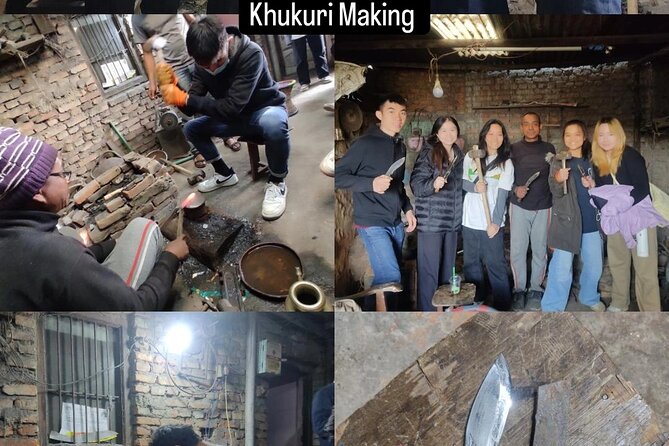
The group size is capped at five people. That is small enough for the blacksmith and guide to give attention to each person, though a group of five may still mean taking turns at the anvil or workbench. A private-feeling setting is one of the strongest reasons to choose this over buying a ready-made knife.
The total time is advertised at about four hours. In practice, allow four to four and a half hours, especially if several people are making knives. Hotel pickup and return add travel time, so do not place this immediately before a fixed evening reservation.
Heating and hammering the raw steel
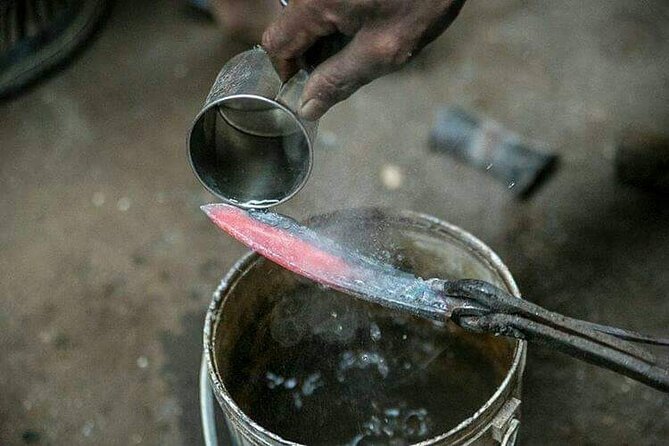
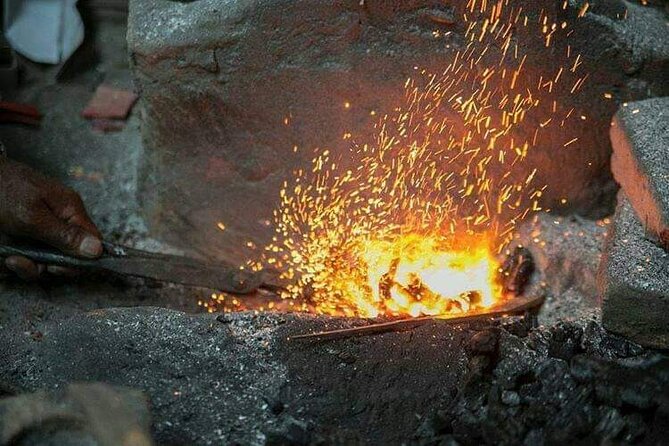
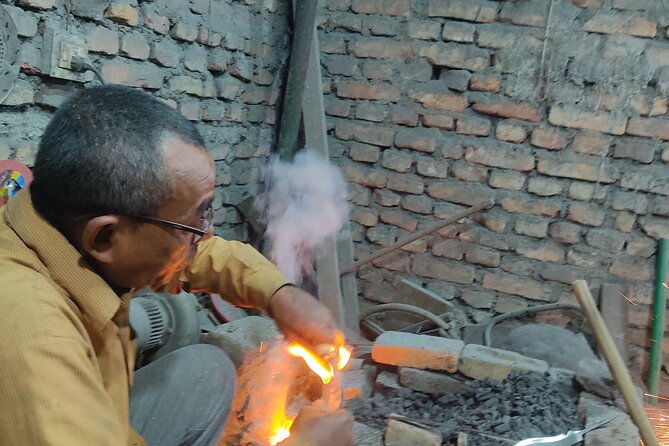
The first real task is hammering the iron. This is the moment when the activity shifts from demonstration to participation. Under Indra’s direction, you help work the heated metal toward the broad, curved shape of a khukuri blade.
You should not expect to develop a finished knife through your own technique alone. A khukuri depends on correct thickness, balance, curvature, and tempering, and those decisions come from years of practice. Your role is to take part in the physical work while the blacksmith controls the result.
That balance works well for most people. You get the feel of striking the metal and see how quickly a skilled smith can correct its shape. You also avoid being left with a poor blade simply because you are learning on the day.
Indra’s hammer work is one of the highlights. He has spent decades making khukuris for local residents and personal orders, and the experience shows in the speed and precision of his movements. His apprentices or family members may help when you need a break, which matters because repeated hammering is tiring.
This is also where the workshop feels least like a standard sightseeing activity. You are not just watching a staged cultural display. You are taking part in a working craft, with the blacksmith deciding how to turn old metal into a useful blade.
Grinding, sparks, and the safety boundary
After the metal has been shaped, the blade needs grinding. This is the part where expectations matter most.
The description of the activity lists first grinding, buffing, and polishing among the steps you can take part in. At the same time, the safety guidance makes clear that the host handles the dangerous blade-grinding work. In practical terms, you may help with an early or controlled grinding stage, but Indra completes the heavy grinding and shaping that produce the final edge.
Stay clear of the sparks. This is not a moment for a close photograph or a casual step toward the wheel. The host has the skill and protective control needed for this part, and your job is to watch from the safe position the guide gives you.
Some descriptions from the experience indicate that people do grind the blade themselves under supervision. This does not conflict with the safety warning if you understand the difference between a limited first grinding and the high-speed finishing work. Ask your guide what you can handle on the day, and follow that instruction rather than assuming every stage is open to participation.
The safety limit is a fair trade. You still see the raw edge become a clean, sharp blade, but you do not risk an injury while trying to copy a master blacksmith. This is one of those workshops where the quality of the final object depends on letting the expert take over at the right point.
Same base, a different kind of day:
- Everest Base Camp Trek – 14 Days
★ 5.0 · 1,499 reviews - Private Kathmandu Sightseeing Tour | UNESCO World Heritage sites
★ 5.0 · 756 reviews - Everest Base Camp Helicopter Tour landing at Everest View Hotel
★ 5.0 · 668 reviews - Everest Base Camp Trekking
★ 5.0 · 485 reviews
Buffing, polishing, and making the knife yours
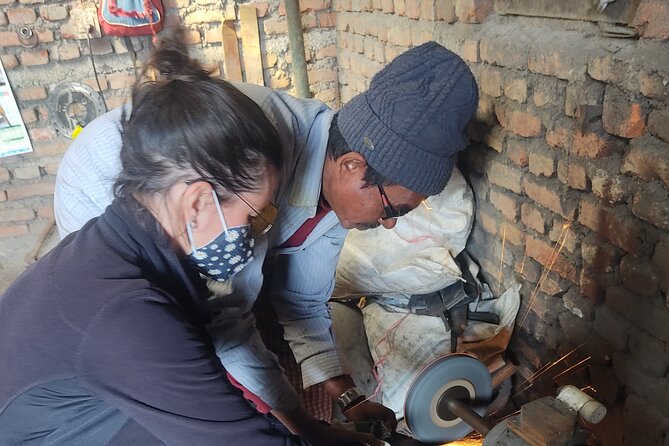
Once the blade has its basic shape, the process moves toward buffing and polishing. This is a satisfying stage because the rough material starts to look like a finished tool.
You may be able to help with the final buffing and polishing under instruction. The exact amount of work depends on your group, your comfort, and the blacksmith’s judgment. Some people want to do as much as possible, while others prefer to watch Indra produce a clean result.
That flexibility is useful. You can hammer and work the knife without pretending to have a blacksmith’s skill. At the same time, you are not simply handed a finished souvenir at the end. The knife contains a visible connection to your time at the forge.
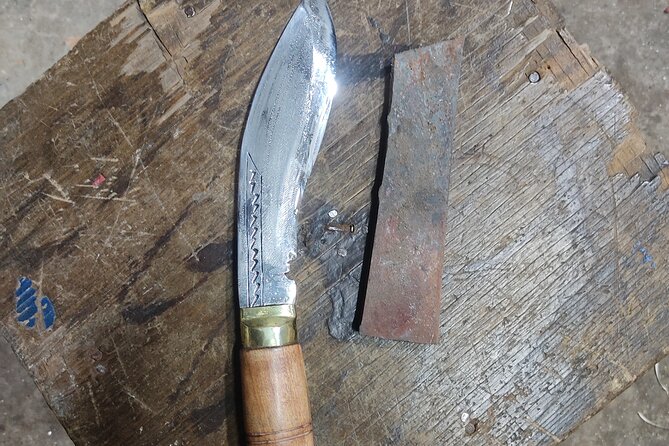
The handle is generally made from wood or buffalo horn, and the finished khukuri is enclosed in a wood and leather scabbard. The result is a compact object with a practical design rather than a decorative trinket. Some participants have also had their knives personalized, so ask the guide what options are available during your visit.
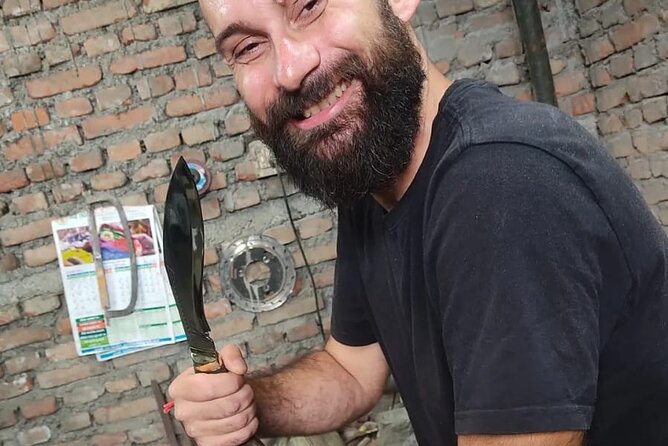
Do not be surprised by how sharp the final knife is. The finished product is described as a genuine, very sharp blade, not a toy or blunt replica. Treat it as a real tool from the moment it is handed to you.
Meeting the blacksmith and his family
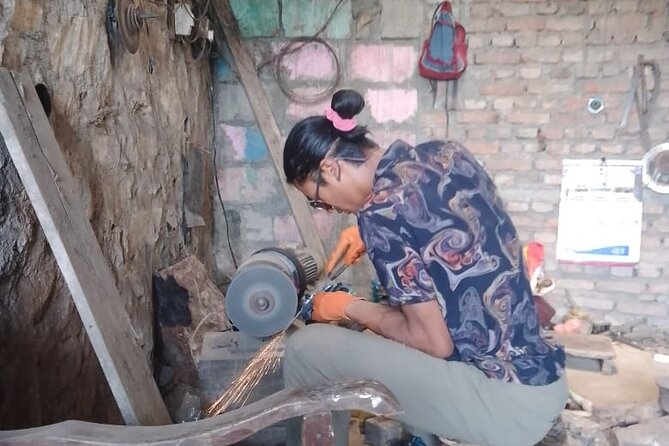
The people are a major part of the experience. Indra is not presented as a distant demonstrator who disappears after the final polish. He and his assistants help you understand the process, answer questions, and guide your hands when needed.
Swoyam has been praised for translation, conversation, and practical help. Namrata has also accompanied participants and added context during the ride and workshop. The quality of the guide matters here because the forge is a home setting, and clear communication helps you know where to stand, when to work, and what the blacksmith is doing.
The atmosphere can feel informal and family-like. Tea may be offered, and some visitors have been invited to share lunch with the family. Lunch is not clearly guaranteed as part of every booking, so treat it as a possible part of the welcome rather than a promised feature.
This contact gives the activity a human scale. You see a craftsperson at work, but you also see the household around the craft. That is more revealing than walking through a shop lined with identical blades.
The setting is not polished. It may feel cramped or basic compared with a commercial workshop. I see that as a fair trade for seeing the craft in its ordinary environment, but it will not suit someone looking for a quiet, air-conditioned class.
Is the $68 price good value?
At $68 per person, the price is reasonable if you value both the hands-on work and the finished knife. You are paying for roughly four hours, hotel pickup and drop-off, a guide, access to an experienced blacksmith, materials, and a six-inch khukuri to take home.
A similar knife from a tourist shop may cost less, especially if you compare only the object. That is the wrong comparison here. The workshop gives you the story of its making, the physical memory of hammering the steel, and time with a local craftsperson.
The value is strongest for someone who would otherwise spend an afternoon shopping for souvenirs. Instead of choosing a mass-produced blade, you help shape one and learn why its construction matters. The knife may also be better quality than a cheap tourist-shop version, though the final finish depends on the blacksmith’s work and the particular piece of steel.
There is one quality concern to keep in mind. On one occasion, cracks appeared in two of three knives during the process. The operator explained that such flaws are not always visible at first and that a replacement knife can usually be made and delivered. This appears to be an occasional forge problem rather than the normal result, but it is worth checking the finished blade carefully before leaving.
The standard price includes the smaller six-inch blade. If you want a 10-inch khukuri, an extra fee may apply. Confirm the size, cost, and packing or transport arrangements before the workshop begins.
Who should book this forge experience?
I would choose this for adults, couples, small groups of friends, and families with older children who can handle a slow, hot, physical activity. It suits anyone interested in tools, metalwork, Nepalese culture, or souvenirs with a story.
It is also a good choice if you have already seen Kathmandu’s temples and shops and want an afternoon that takes you into a different part of local life. You do not need blacksmithing experience. The blacksmith and assistants guide you through the work.
Families should think carefully about the four-hour length. Two young children, ages four and six, enjoyed parts of the visit but lost patience before the knives were complete. If you bring children, pack something to occupy them during the repetitive stages, or consider booking without very young children.
You should skip it if you dislike heat, sparks, noise, or the sight of sharp tools. It is also not the right pick if you want complete control over every stage. The host must take over important parts of the work, and the final knife reflects both your participation and Indra’s skill.
Practical details that affect your day
The activity accepts mobile tickets, and confirmation is provided at booking. Most people can participate, but the forge environment requires you to follow safety directions and stay away from the active grinding area.
Arrange your pickup location clearly. The operator has been unable to collect people from locations far outside Kathmandu, and a same-day booking with late pickup details can create problems. A cancellation made at least 24 hours before the start time qualifies for a full refund. Changes or cancellations inside 24 hours are not accepted under the stated policy.
Wear clothes and shoes suitable for a working forge. The supplied information does not specify a dress code, but you should expect dust, heat, metal, and sparks. Keep loose items under control and follow the guide’s instructions around the forge.
The finished knife may be very sharp, so think about how you will transport it after the workshop. If you are flying onward, ask about safe packing and airline or border rules before you book. The workshop provides the knife, but it cannot control the regulations of your next destination.
Should you book the Khukuri Making Workshop?
Yes, if you want a personal souvenir and do not mind sharing the work with a master blacksmith. The strongest parts are the home forge, Indra’s decades of skill, the small group, and the chance to carry away a real Nepalese blade you helped shape.
Book with realistic expectations. You will hammer the metal, take part in selected grinding and polishing stages, and watch the blacksmith complete the technical work. You will not independently build every part of the knife.
For a first visit to Kathmandu, this is a strong choice for an activity beyond the usual monuments and shopping streets. The $68 fee makes sense when you count the transport, guide, instruction, materials, and finished six-inch khukuri. If you want a calm class or a quick souvenir stop, choose something else. If you want a hot forge, a skilled maker, and a knife tied to your own afternoon in Nepal, book it.
FAQ
How long does the khukuri workshop last?
The experience lasts about four hours, though some sessions run approximately four and a half hours, especially when more than one person is making a knife.
What size knife is included?
The standard workshop includes a small khukuri with a blade of about six inches.
Can I make a larger 10-inch khukuri?
One description states that a 10-inch khukuri may be available for an additional fee. Confirm the option and price before the workshop.
Do I make the entire knife myself?
No. You take part in hammering the iron, the first grinding, and the final buffing and polishing. The host completes the most technical and dangerous grinding work.
Is the blade grinding safe for participants?
The host handles the blade grinding that creates sparks and advises you to stay clear during this stage. Follow the safety instructions and ask what limited grinding work you may do under supervision.
Where does the workshop take place?
The workshop takes place at the home of the blacksmith, Indra, in a more remote part of Kathmandu.
Is hotel pickup available?
Yes. Pickup and drop-off from a Kathmandu hotel are offered. You should provide your exact pickup location promptly, particularly for a same-day booking.
What is included in the $68 price?
The price is $68 per person and includes the approximately four-hour workshop, the standard six-inch khukuri, materials, and the offered pickup service. The supplied information does not state that lunch is guaranteed.
Can I cancel for a full refund?
You can cancel at least 24 hours before the local start time for a full refund. Cancellations and changes made less than 24 hours before the experience are not accepted.
Just added in Kathmandu
- Kathmandu to Chitwan Tour by Tourist Bus – A Convenient and Affordable Way★ 4.0 · 4 reviews
- Changunarayan Hill to Telkot Hike Near Kathmandu Day Tour★ 5.0 · 6 reviews
- Mt Everest Base CampTrek | Budget Package★ 5.0 · 4 reviews
- Chitwan Jungle Safari 3-Day Tour★ 5.0 · 9 reviews
- Chandragiri Hill Station Tour by Cable Car★ 5.0 · 4 reviews
- Chandragiri Hills cable car day trip, private car with driver from Kathmandu★ 5.0 · 8 reviews
- Chandragiri to Taudaha Nature Day Hiking from Kathmandu★ 5.0 · 13 reviews
- Chandragiri Cable Car & Monkey Temple Private Guided Day Tour★ 5.0 · 5 reviews
Workshops, compared.
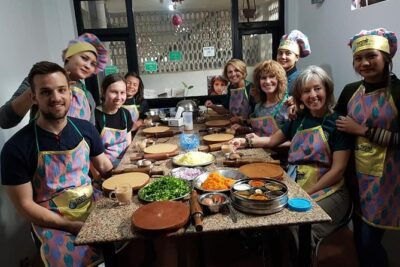
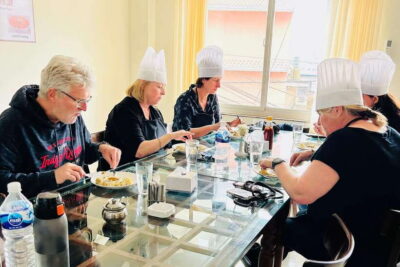
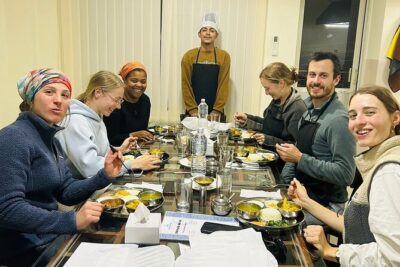
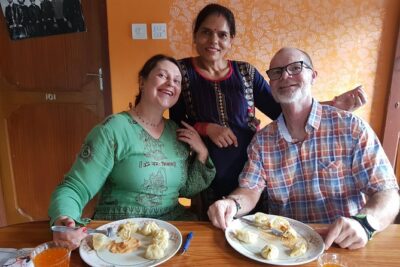
Nepalese Momos or Dal Bhat Cooking Class (Cook with Delight)
Read our review →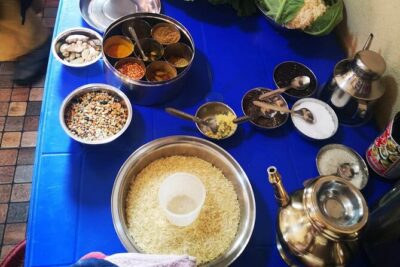
The best Private Nepali Cooking Class in Kathmandu
Read our review →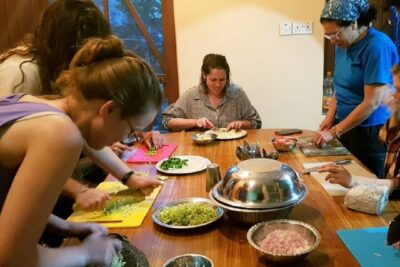
Nepalese Kitchen in Pokhara: Momos or Dal Bhat Cooking Class
Read our review →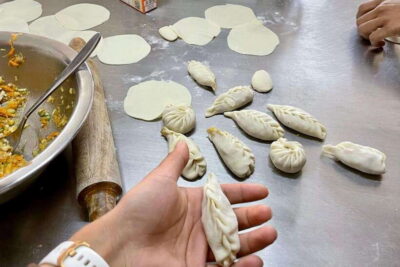
Browse the lists this tour appears in